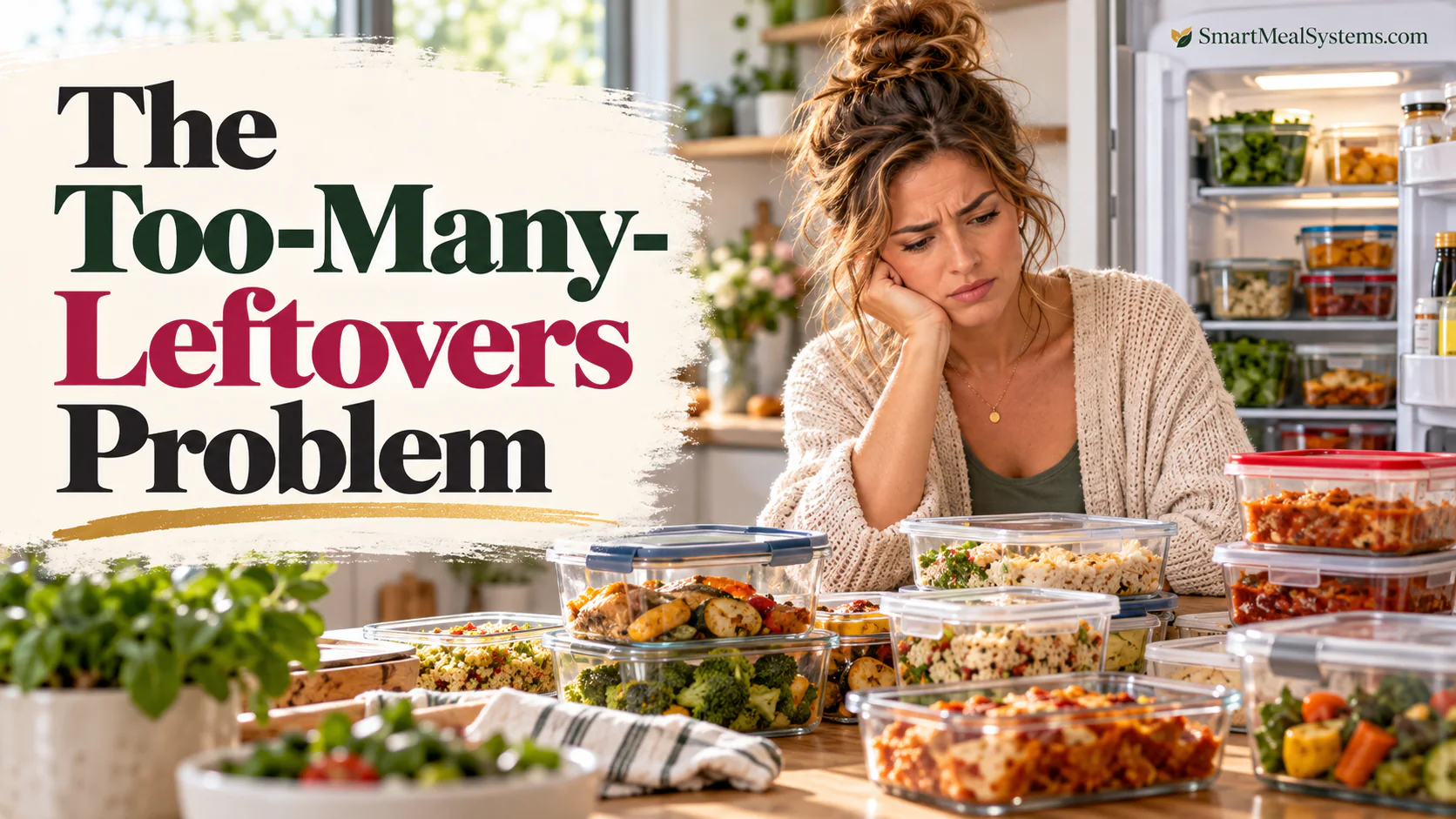
You cooked a big dinner. Everyone ate. Now there is a container of something in the fridge, and then another, and by Thursday there are four, nobody feels like eating any of them, and one is quietly growing a coat.
Leftovers are supposed to save time and money. When they aren’t planned for, they do the opposite. The fix is to decide what happens to leftovers before you cook, not after.
Why leftovers pile up
Most leftover waste comes from a handful of causes:
- Cooking more than the household eats, without a plan for the extra.
- Not knowing what is in the fridge. Containers stack up and hide each other.
- No slot in the week for eating them.
- Food fatigue. The same meal for three days in a row.
- Leftovers that don’t reheat well or have no obvious next use.
- Buying new food before the old food is gone.
Each of these has a straightforward remedy.
Fix 1: Cook the right amount
Start before the pot is on the stove. If leftovers regularly go uneaten, you are probably cooking too much, or cooking the wrong kind of meal for repeating.
Some rough guidance:
- Pasta and rice: about a half cup to a cup of cooked grain per adult, depending on appetite and what else is on the plate. Measure dry amounts the first few times so you learn your household’s needs.
- Meat: around a quarter to a third of a pound per person, cooked.
- Soups and stews: these are the safest meals to over-make, because they freeze well.
Keep a quick note after dinner: “too much,” “just right,” or “ran out.” After a few meals you’ll know how to scale.
Fix 2: Decide in advance what the extra becomes
The most effective change is to plan leftovers as an ingredient for another meal, before you cook the first one.
| Cook this | On purpose, to make | Next-day meal |
|---|---|---|
| Roast chicken | Extra meat | Quesadillas, chicken salad, soup |
| Rice | Extra grain | Fried rice, burritos, rice pudding |
| Pot of chili | Extra portion | Baked potatoes, nachos, chili mac |
| Roasted vegetables | Extra tray | Grain bowls, frittata, pasta |
| Taco meat | Extra seasoned meat | Taco salad, nachos, stuffed peppers |
| Pasta sauce | Extra sauce | Pizza, lasagna, meatball subs |
| Pulled pork or shredded beef | Extra meat | Sandwiches, tacos, rice bowls |
Write the second meal into your plan right next to the first. When the leftover has a destination, it gets used.
Fix 3: Give leftovers a scheduled night
If you never plan a leftover night, leftovers fight for space in the fridge and lose. Pick one dinner each week, often mid-week or the night after a big cook, to eat what is there.
A leftover night also gives you a free evening. It requires almost no cooking and clears the fridge before the next shop.
For households with picky eaters, serve it buffet-style: put out all the leftovers and let each person build a plate.
Fix 4: Make leftovers visible
You cannot eat what you cannot see.
- Use clear containers, or label opaque ones.
- Write the date on tape on each lid.
- Put leftovers at eye level, on a dedicated “eat first” shelf.
- Do a quick fridge check before you plan and shop. How to Stop Wasting Groceries has a ten-minute routine for it.
As a general guide, leftovers are best eaten within about three to four days. If you won’t get to something by then, freeze it that same day. Check a trusted food-safety source for specific items.
Fix 5: Freeze early
The most useful leftover habit is to freeze quickly, not on day four when the food is already questionable.
When you cook a large batch, divide it into meal-sized portions right away. Eat one or two portions during the week and freeze the rest. Labeled and dated, that food becomes a “free” dinner on a busy night later.
Good candidates include soup, chili, sauces, cooked grains, shredded meat, and casseroles. Soups and sauces freeze flat in bags and thaw quickly. The Free Printable Freezer Inventory Sheet keeps a record of what is in there.
For more on this, see How to Batch Cook: The Complete Guide.
Fix 6: Transform it, don’t repeat it
Food fatigue is real. Eating the same meal three nights in a row feels like a punishment. The solution is to change the format.
- Chili becomes baked potatoes, nachos, or chili mac.
- Roast chicken becomes tacos, soup, or a salad.
- Rice becomes fried rice or burritos.
- Roasted vegetables become a frittata or pasta.
- Mashed potatoes become potato pancakes.
- Stale bread becomes croutons, French toast, or bread pudding.
Changing the sauce, the topping, or the shape of the meal makes it feel new.
Fix 7: Cook components, not full meals
If leftovers of complete meals keep going to waste, cook the building blocks instead. A pot of rice, a tray of vegetables, and shredded chicken can become three different dinners across the week, so nothing is a “leftover” in the first place.
That’s the idea behind our 3-3-3 Batch Cooking Method.
Fix 8: Use the “use it up” mindset
Treat the fridge like a menu for the first part of the week. Before you buy anything new, ask what you already have that could become dinner. The Use It Up Meal System is a full framework for it, and The One-Ingredient-In, One-Meal-Out Pantry Method keeps stock from piling up.
A week of planned leftovers
Here is what this looks like in practice.
| Day | Dinner | Leftover plan |
|---|---|---|
| Sunday | Roast chicken, potatoes, green beans | Save the meat; save the bones for stock |
| Monday | Chicken quesadillas | Uses Sunday’s chicken |
| Tuesday | Chili in the slow cooker | Double batch |
| Wednesday | Leftover night | Chili, remaining chicken, and sides |
| Thursday | Baked potatoes topped with chili | Uses Tuesday’s extra |
| Friday | Soup from the chicken stock | Freeze half |
| Saturday | Flexible: eat out or clear the fridge | Margin |
Four dinners come from two cooking sessions, and nothing is thrown away.
When leftovers still pile up
If you do all of this and still have too much, consider:
- Shrinking recipes to match your household.
- Freezing sooner, on the first day.
- Sharing: bring a container to a neighbor or friend.
- Changing how you cook: components instead of full meals.
- Giving yourself permission to throw out food that is past safe use. Don’t eat questionable leftovers to avoid waste.
A quick checklist
- Note how much your household actually eats.
- Plan a second meal for any extra before you cook.
- Schedule a leftover night each week.
- Label, date, and place leftovers where you can see them.
- Freeze portions early.
- Transform leftovers instead of repeating them.
Make this easier
Turn what is in your fridge into a day-by-day plan with the free Leftover Plan Builder, then plan the week, including a leftover night, with the Dinner Rotation Builder.
Leftovers are a quiet source of savings when they are planned. Decide what they will become before you cook, and they stop being clutter and start being tomorrow’s easy dinner.
Turn the idea into a system.
Keep Reading