Batch cooking often fails because it asks you to predict exactly what you will want to eat five days from now.
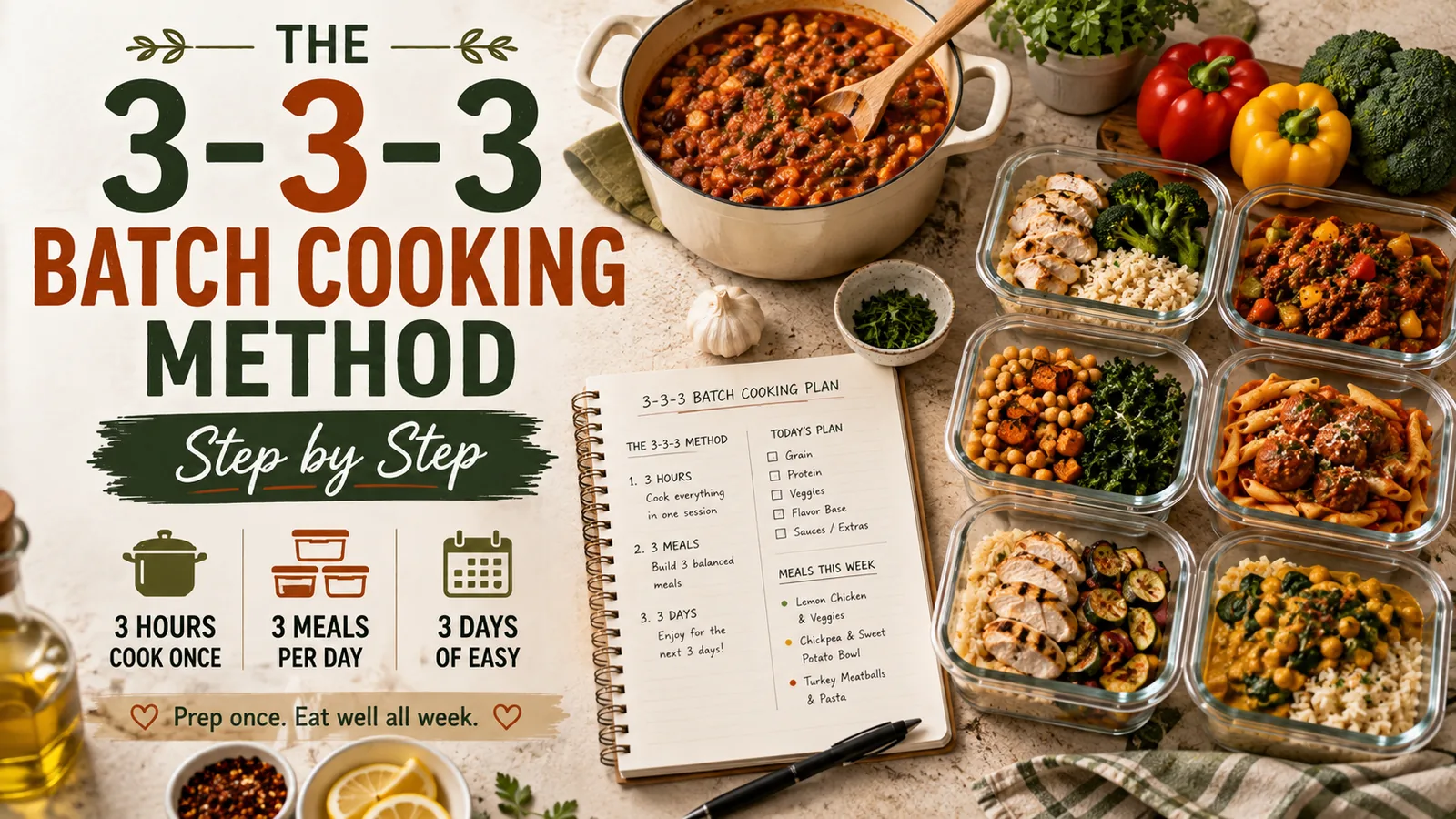
The 3-3-3 method solves that by prepping components, not seven finished dinners.
You cook:
- 3 proteins
- 3 bases
- 3 flavor builders
Then combine them differently through the week.
The 3-3-3 formula
3 Proteins
Choose three flexible proteins.
3 Bases
Choose three starches or meal foundations.
3 Flavor Builders
Choose three sauces, toppings, or vegetable mixes that change the direction of the meal.
You do not need nine separate recipes.
You need nine useful building blocks.
Step 1: choose three proteins
Pick proteins that can cross cuisines.
Good options:
- shredded chicken;
- ground turkey or beef;
- roasted chickpeas or lentils;
- baked tofu;
- hard-boiled eggs;
- pulled pork;
- simple baked salmon for early-week meals.
Avoid making all three proteins heavily seasoned in completely different directions.
A neutral base gives you more options.
Example protein set
- shredded chicken;
- taco-seasoned ground turkey;
- lentils.
This gives you meat and plant-based flexibility.
Step 2: choose three bases
Bases should be cheap, easy to store, and useful with more than one protein.
Examples:
- rice;
- roasted potatoes;
- pasta;
- quinoa;
- tortillas;
- greens;
- couscous;
- baked sweet potatoes.
Example base set
- brown rice;
- roasted potatoes;
- tortillas.
Now you can make bowls, plates, tacos, wraps, or loaded potatoes.
Step 3: choose three flavor builders
This is what prevents the system from tasting repetitive.
Flavor builders can be:
- salsa + lime;
- pesto;
- yogurt-garlic sauce;
- teriyaki;
- marinara;
- curry sauce;
- roasted vegetables;
- slaw;
- pickled onions;
- shredded cheese + herbs.
Choose three that create distinct meal directions.
Example set
- salsa + lime slaw;
- pesto + roasted vegetables;
- yogurt-herb sauce.
Now shredded chicken can become three different meals without being cooked three times.
The matrix
Here is the power of the method:
| Protein | Base | Flavor | Meal |
|---|---|---|---|
| Chicken | Rice | Salsa/slaw | Burrito bowl |
| Chicken | Potatoes | Yogurt-herb | Loaded potato plate |
| Chicken | Tortillas | Pesto/veg | Wrap |
| Turkey | Rice | Salsa/slaw | Taco bowl |
| Turkey | Potatoes | Yogurt-herb | Meat + potato bowl |
| Lentils | Rice | Pesto/veg | Lentil grain bowl |
| Lentils | Tortillas | Salsa/slaw | Lentil tacos |
You do not have to make all combinations. The point is that the system creates options.
Core idea9 components → many possible meals
A 90-minute batch session
You can run 3-3-3 in about 90 minutes if you overlap tasks.
0-10 minutes: start long-cook items
- preheat oven;
- start rice;
- put potatoes in oven;
- start chicken.
10-30 minutes: cook second protein + prep vegetables
Brown ground turkey.
Chop slaw or vegetables while proteins cook.
30-50 minutes: make sauces
Mix two quick sauces and portion one store-bought sauce if using.
Examples:
- yogurt + lemon + herbs;
- salsa + lime;
- pesto loosened with olive oil.
50-70 minutes: cook plant protein
Warm/season lentils or roast chickpeas.
Check potatoes and chicken.
70-90 minutes: cool and portion
Do not assemble every meal.
Store components separately.
That is what keeps the week flexible.
How much food to make
For a household of four, you do not need three full family-size batches of everything.
Start with:
Proteins
- 1.5-2 lb chicken
- 1 lb ground meat
- 2-3 cups cooked lentils/beans
Bases
- 3 cups cooked rice
- 2 lb potatoes
- 12 tortillas
Flavor builders
- 1-2 cups each
Adjust for lunches and household size.
The system scales better when you think in servings, not containers.
The 3-3-3 grocery list structure
Proteins
- chicken
- ground turkey
- lentils
Bases
- rice
- potatoes
- tortillas
Flavor
- salsa
- cabbage/slaw
- limes
- yogurt
- herbs
- pesto
- roasting vegetables
Flexible extras
- cheese
- avocado
- greens
- fruit
A short list with overlapping ingredients is easier to shop and easier to use.
How to schedule the meals
Do not assign every combination before the week begins.
Use a loose order:
Early week
Use ingredients with shorter fridge life.
Midweek
Use cooked proteins and fresh toppings.
Late week
Use freezer-safe components, tortillas, sauces, or reheat-friendly bowls.
If something will not be eaten within a safe refrigerated window, freeze it promptly rather than assuming Friday-you will remember.
Three sample 3-3-3 setups
Budget setup
Proteins: eggs, lentils, chicken thighs
Bases: rice, potatoes, tortillas
Flavor: salsa, marinara, yogurt sauce
Family setup
Proteins: shredded chicken, meatballs, beans
Bases: pasta, rice, rolls/wraps
Flavor: tomato sauce, taco toppings, pesto vegetables
High-chaos setup
Proteins: rotisserie chicken, pre-cooked meatballs, canned beans
Bases: microwave rice, tortillas, frozen potatoes
Flavor: jarred salsa, bagged slaw, bottled sauce
The method still works even if most components are convenience foods.
Common mistakes
Mistake 1: seasoning everything aggressively
If the chicken already tastes strongly Mediterranean, it is harder to turn into tacos.
Keep at least one protein neutral.
Mistake 2: assembling five identical bowls
That removes flexibility and creates boredom.
Store components separately.
Mistake 3: making too much
Batch cooking is not helpful if half gets thrown away.
Start smaller than you think.
Mistake 4: forgetting texture
Include at least one fresh/crunchy element: slaw, herbs, cucumber, lettuce, toasted seeds.
Mistake 5: cooking nine complicated things
The 3-3-3 method should simplify the session.
Use one oven, one stovetop, and quick sauces when possible.
The 3-3-3 planning card
- Choose 3 flexible proteins
- Choose 3 bases
- Choose 3 flavor builders
- Check that ingredients overlap
- Start longest-cook foods first
- Store components separately
- Freeze anything you will not use soon
- Combine components based on the day, not a rigid schedule
Why this works better than seven containers
The 3-3-3 method separates cooking decisions from eating decisions.
You decide once what to prep.
Later, you can decide whether tonight feels like tacos, a bowl, pasta, or loaded potatoes without starting from zero.
That is exactly what a useful meal system should do: reduce work now without removing flexibility later.
Turn the idea into a system.
Keep Reading