“Use what you have” sounds simple until you stand in front of a refrigerator containing half a bell pepper, leftover rice, three eggs, an open jar of salsa, and no obvious dinner.
The problem is rarely a total lack of food.
It is that the food you have does not arrive pre-organized into meals.
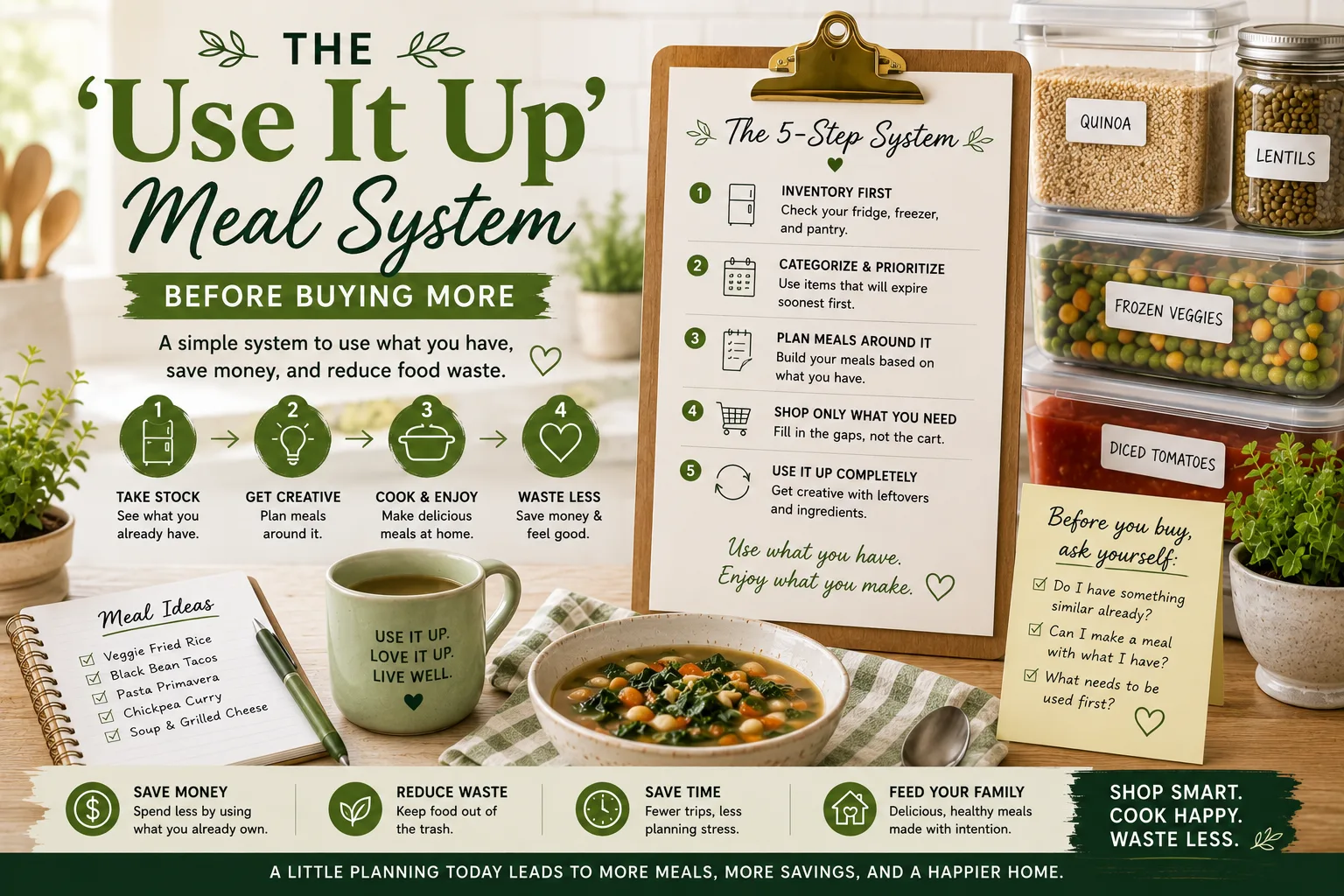
The Use It Up Meal System fixes that by giving leftover and open ingredients a predictable path from kitchen inventory to dinner.
The system in five steps
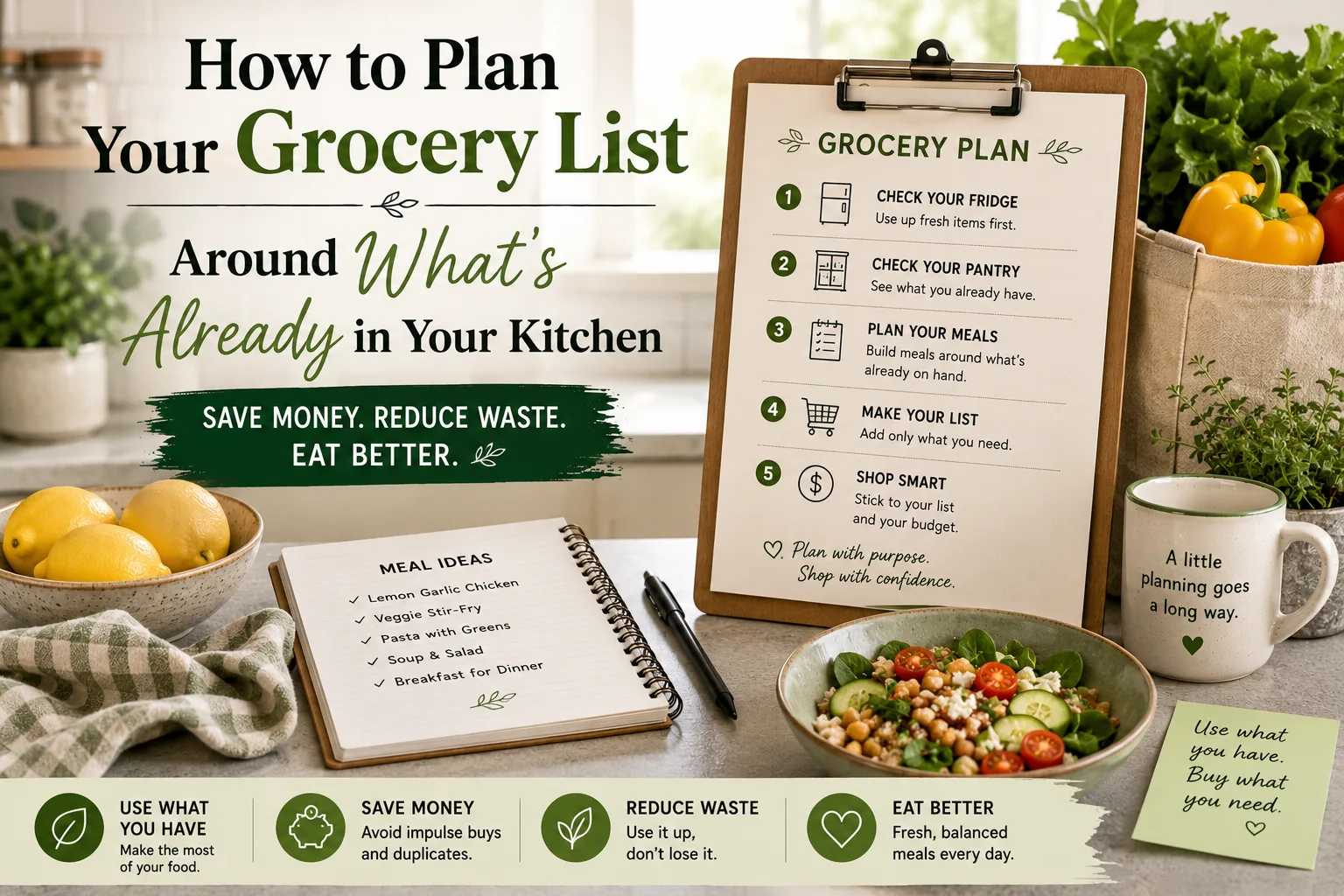
Use this sequence:
Spot → Group → Choose a Format → Fill the Gaps → Finish
You are not trying to create a clever recipe from random scraps. You are identifying ingredients with a reason to be eaten soon and putting them into meal formats flexible enough to absorb them.
Step 1: spot the foods that need a job
Once or twice a week, scan the kitchen for foods that are easy to forget.
Look for:
- cooked leftovers;
- open packages;
- partial vegetables;
- small amounts of cheese;
- cooked rice or grains;
- tortillas nearing the end of the pack;
- herbs;
- open jars of sauce;
- older freezer portions;
- pantry ingredients you keep skipping.
Choose five to seven, not twenty.
Too many ingredients create another decision problem.
Step 2: group compatible ingredients
Do not ask, “What recipe uses half a pepper?”
Ask, “What else do I have that could go with this?”
Example:
- cooked rice;
- half pepper;
- two eggs;
- frozen peas;
- leftover chicken.
That group clearly points toward fried rice.
Another group:
- tortillas;
- black beans;
- shredded cheese;
- salsa;
- half onion.
That points toward quesadillas, tacos, or burrito bowls.
Grouping reveals meals faster than searching ingredients individually.
Step 3: choose one of eight flexible meal formats
These formats handle leftovers particularly well.
1. Fried rice
Best for: cooked rice, eggs, small vegetables, leftover meat.
2. Tacos, wraps, or quesadillas
Best for: beans, cooked proteins, cheese, vegetables, sauces.
3. Pasta
Best for: vegetables, herbs, cheese, sauces, small protein portions.
4. Soup
Best for: broth, beans, grains, vegetables, cooked meat.
5. Grain bowls
Best for: rice/quinoa, proteins, roasted vegetables, sauces.
6. Eggs
Best for: vegetables, cheese, herbs, potatoes, bread.
7. Sheet-pan dinner
Best for: raw vegetables, proteins, potatoes, sausages.
8. Loaded toast, potatoes, or flatbreads
Best for: smaller amounts that cannot carry a full meal alone.
Keep this list visible. It turns “random food” into recognizable dinner structures.
Step 4: buy completion ingredients, not a new kitchen
Using food up does not mean refusing to buy anything until the refrigerator is empty.
Sometimes one purchase unlocks several ingredients.
If you have beans, rice, salsa, and cheese, buying lettuce and avocado can turn them into satisfying bowls.
If you have pasta, tomatoes, and parmesan, buying spinach may complete dinner.
The rule is:
Buy the smallest number of ingredients needed to make existing food easy to eat.
That is different from choosing an unrelated recipe and buying ten new ingredients while the old food continues waiting.
Step 5: finish before replacing
When you empty something during a Use It Up week, do not automatically replace it.
Ask:
- Is it a true staple?
- Will we use it in the next two weeks?
- Do we own an alternative?
- Did we actually enjoy it?
If not, leave the space empty.
This is how the system gradually improves your pantry instead of simply cycling through the same overstock.
The Use It Up priority order
When deciding what to eat first, use this hierarchy:
1. Perishable fresh food
2. Cooked leftovers
3. Open packages
4. Older freezer food
5. Pantry overstock
A can of beans can wait longer than fresh spinach. Use urgency to make the first decisions for you.
The “one dinner + one lunch” rule
Leftovers often become waste because people plan an entire second family dinner around a quantity that is too small.
Instead, designate smaller portions for lunch.
If taco night leaves one serving of beans, some rice, and toppings, that may be tomorrow’s lunch—not a new dinner problem.
This keeps the dinner plan flexible while still using the food.
A sample Use It Up week
What needs using
- half bag spinach;
- cooked rice;
- 4 tortillas;
- open salsa;
- shredded cheese;
- 2 chicken breasts in freezer;
- 1 can chickpeas;
- half box pasta;
- carrots;
- 3 eggs.
Meal 1: Chicken rice bowls
Use chicken, rice, salsa, spinach, and cheese.
Meal 2: Chickpea pasta
Use pasta, chickpeas, spinach, and carrots with a simple sauce.
Meal 3: Quesadillas
Use tortillas, remaining cheese, salsa, and leftover chicken/chickpeas.
Meal 4: Egg fried rice
Use remaining rice, eggs, carrots, and any compatible vegetables.
One group of ingredients has now moved through four meals without requiring four unrelated shopping lists.
Create a Use It Up box
Put small or priority foods together physically when possible.
In the refrigerator, use a clear bin or one shelf section.
In the pantry, use a basket.
In the freezer, use one front-facing area.
Label it USE FIRST.
The point is not organization for its own sake. Visibility prevents the foods you selected from disappearing behind newer purchases.
Schedule a weekly Use It Up dinner
Pick one night—often Thursday, Friday, or the night before grocery shopping—as the default clean-out dinner.
Do not assign a recipe in advance.
Assign a format:
- Friday = quesadillas/wraps;
- Thursday = fried rice;
- Sunday lunch = frittata;
- pre-shop night = soup or bowls.
Then fill that format with whatever needs using that week.
This makes food-waste reduction part of the schedule rather than a rescue mission.
What about ingredients that do not fit together?
Do not force combinations simply to finish everything simultaneously.
Use ingredients across different eating occasions.
For example:
- berries → breakfast;
- half cucumber → lunch;
- rice → dinner;
- stale bread → breadcrumbs or toast;
- herbs → sauce or garnish;
- one soup portion → work lunch.
“Use It Up” applies to the whole food week, not just dinner.
Keep an “I won’t buy this again” note
Waste contains useful information.
If the same ingredient repeatedly ends up in the Use It Up zone, ask why.
Maybe the package is too large. Maybe only one person likes it. Maybe you buy it aspirationally. Maybe a smaller frozen version would work better.
Write down those patterns.
Saving money is not only about using every purchase. It is also about stopping purchases that repeatedly create work and waste.
The 15-minute pre-shop reset
Before your regular grocery trip:
- Find five foods to prioritize.
- Group compatible items.
- Assign them to flexible meal formats.
- Add only the completion ingredients to your list.
- Delay replacing nonessential foods you finish.
That is the entire system.
You do not need a zero-waste kitchen or elaborate leftover recipes.
You need a repeatable moment when the food already in your home gets considered before new food comes through the door.
Once that habit becomes automatic, “using it up” stops feeling like a challenge and starts becoming a normal part of meal planning.
Turn the idea into a system.
Keep Reading