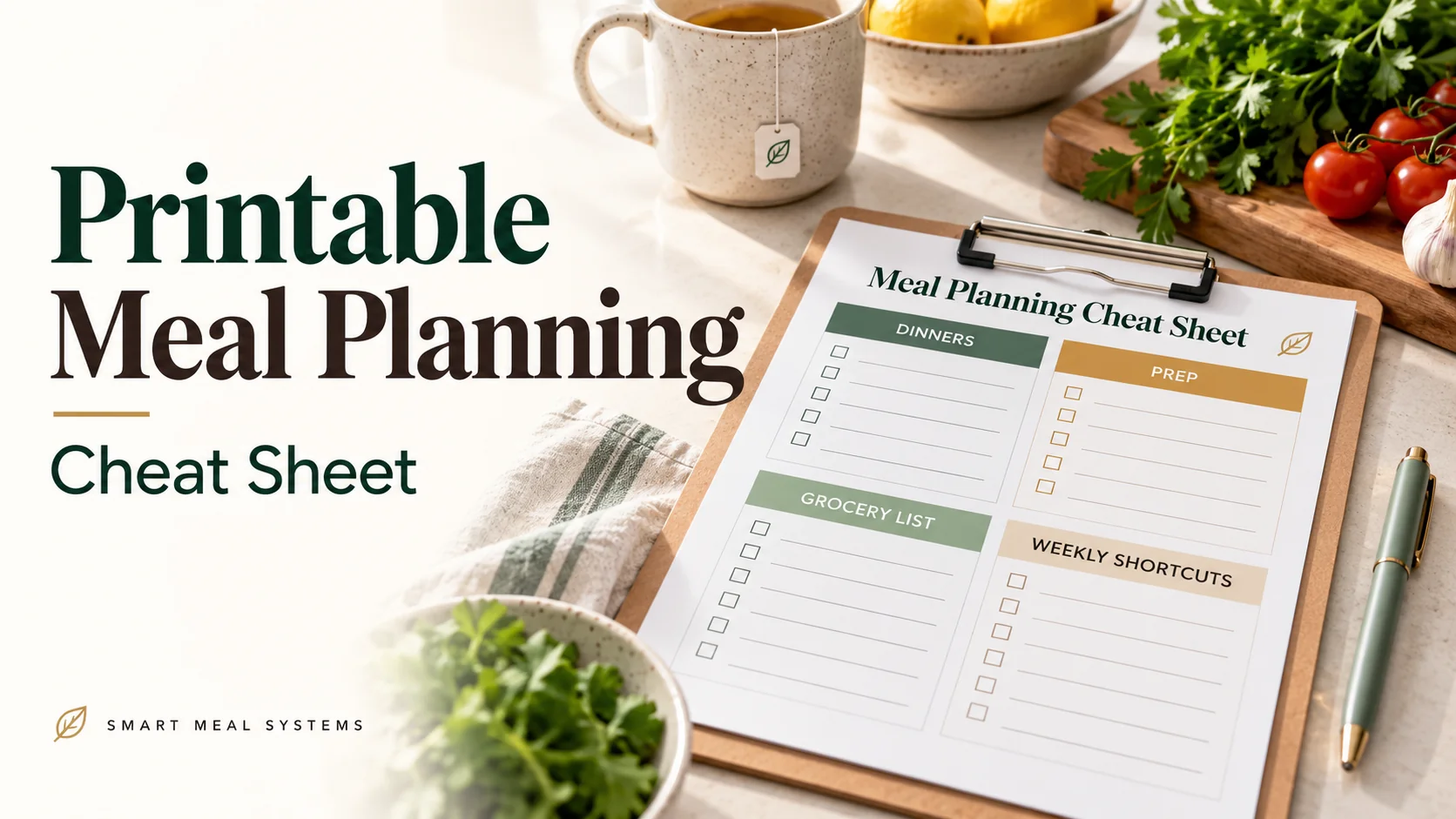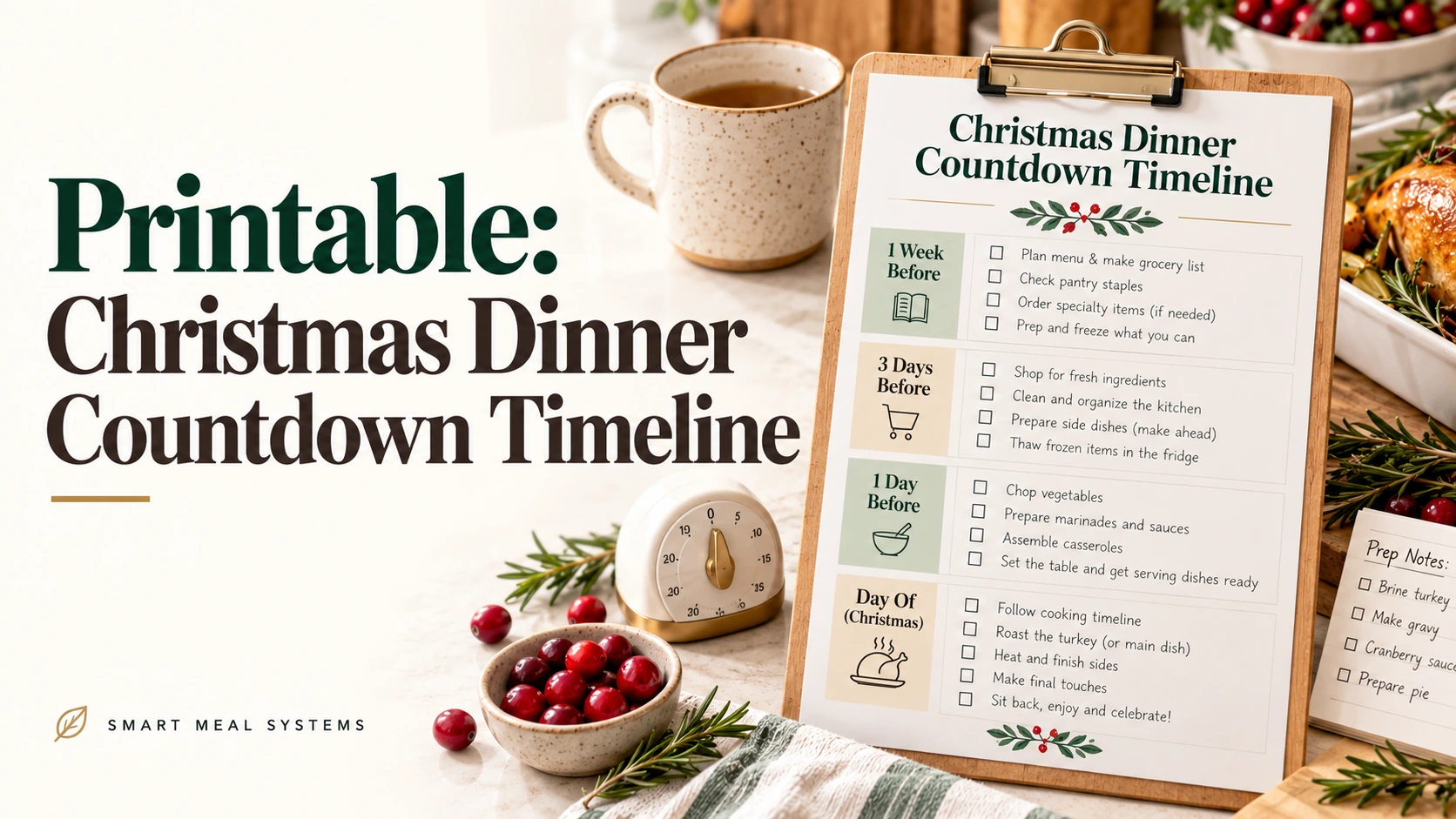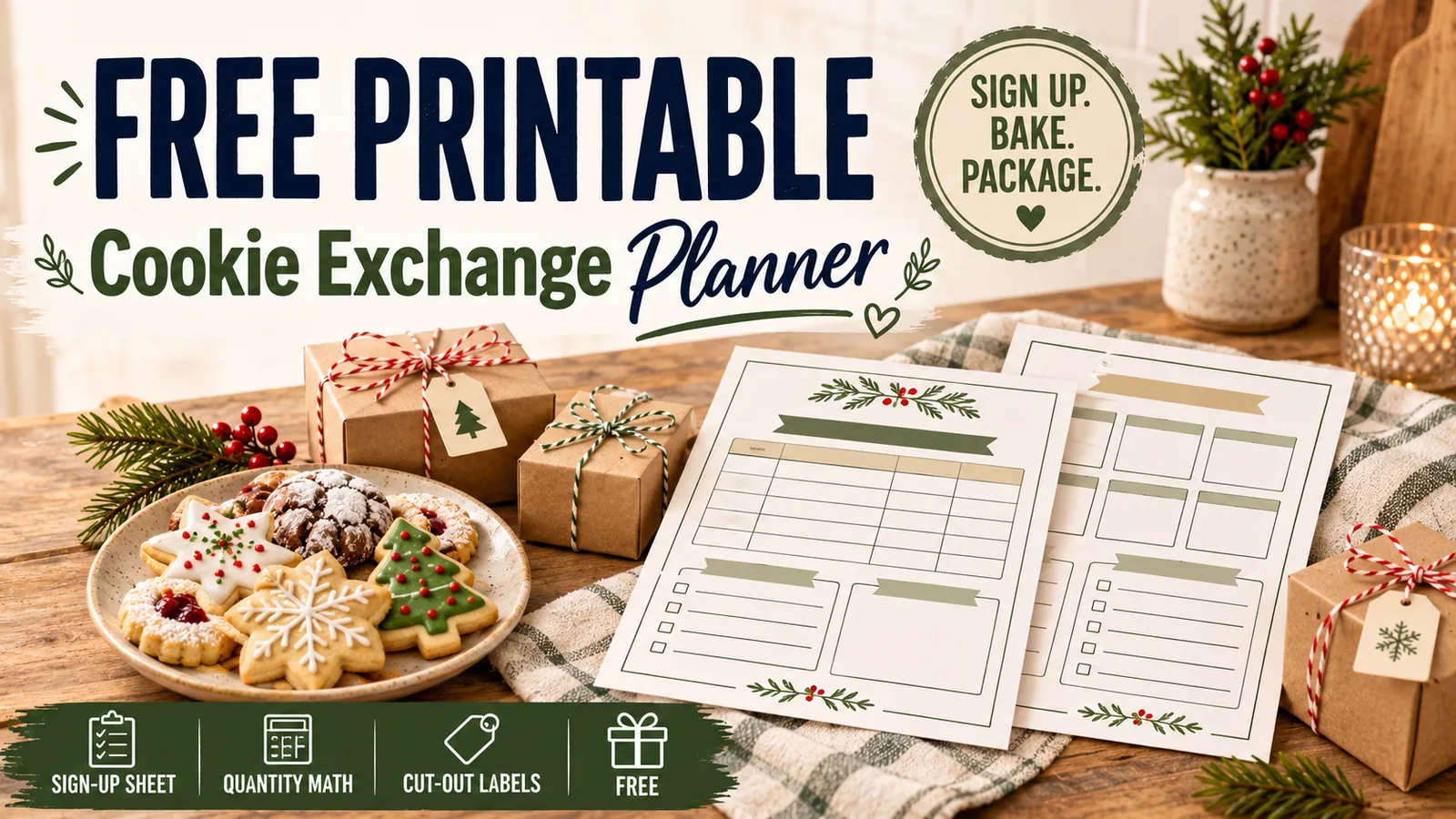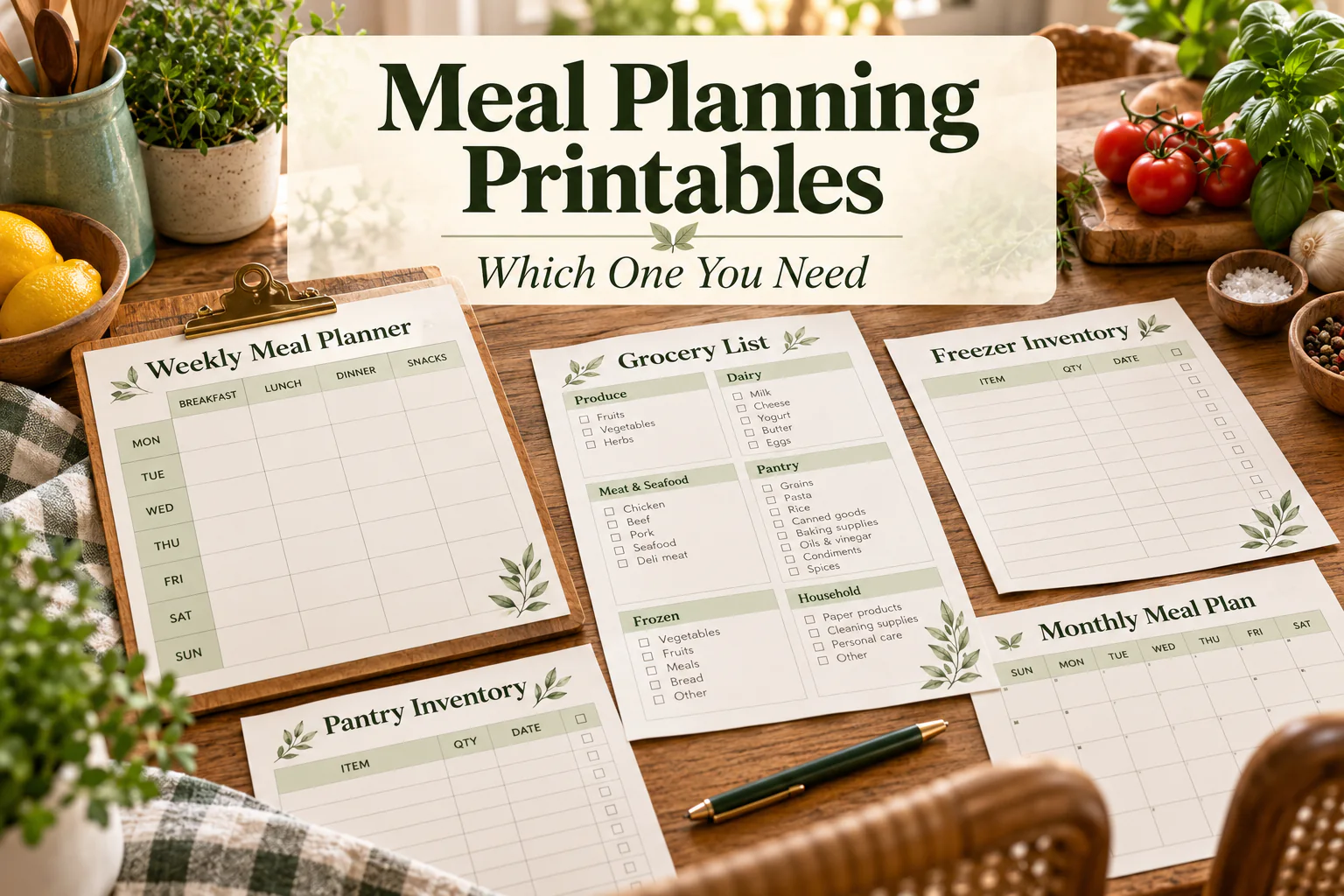
Search for meal planning printables and you will find hundreds. Most look nice. Fewer actually change how your week runs.
This guide explains the main types, what each is for, and how to choose the one that solves your particular problem, so you print one useful page instead of ten.
Start with the problem, not the template
Different printables fix different problems. Ask which sounds most like you:
- “I never know what we’re having.” You need a weekly meal planner.
- “I forget things at the store.” You need a grocery list.
- “Things get lost in my freezer.” You need a freezer inventory.
- “My pantry is chaos and I buy duplicates.” You need a pantry sheet.
- “I spend too much on food.” You need a budget tracker.
- “I make the same decisions every week.” You need a rotation or master list.
The main types
Weekly meal planner
A grid with the days of the week and spots for dinner, and sometimes breakfast, lunch, and snacks. This is the foundation. Pick a version with space for a short notes or “prep” line, and a place to mark busy nights.
Good for: beginners, anyone building a weekly routine. Try: the Free Weekly Meal Planning Template or the 2027 Meal Planning Printable.
Monthly or yearly calendar
A calendar view helps you see the whole month: appointments, events, and which nights call for a freezer meal. Useful for families with busy schedules.
Good for: planning around events, recurring commitments, and holidays. Try: the 2027 Meal Planning Calendar.
Grocery list
The best versions are grouped by store section (produce, dairy, meat, pantry, frozen), so you walk the store once. Some include a column for “already have,” which saves buying duplicates.
Good for: reducing forgotten items and extra trips.
Freezer inventory
A running list of what is in your freezer, with the date it went in. This is the page that prevents mystery bags and freezer burn.
Good for: batch cookers. Try: the Free Printable Freezer Inventory Sheet and the 3-Column Freezer Rotation System.
Pantry organization sheet
Lists your staples by category so you know what to restock and what to use up first.
Good for: anyone who regularly buys a third jar of paprika. Try: Pantry Organization System by Category.
Budget tracker
A simple page to record weekly or monthly grocery spending against a target.
Good for: households actively working on food costs. See How to Build a Grocery Budget From Scratch.
Master dinner list
A one-page list of your household’s go-to meals. It looks simple, but many people find it more helpful than any weekly grid, because it answers “what should I make?” in seconds.
Good for: ending decision fatigue.
Which printable for which situation
Match your situation to a starting set instead of downloading everything.
| Your situation | Start with | Add later |
|---|---|---|
| New to meal planning | Weekly meal planner + grocery list | Master dinner list |
| Overwhelmed by daily decisions | Master dinner list + 2-week rotation | Weekly planner |
| Food costs too high | Grocery list + budget tracker | Pantry sheet |
| Freezer full of mystery food | Freezer inventory | Batch cooking planner |
| Busy family calendar | Monthly calendar + weekly planner | Rotation |
| Hosting a holiday or party | Event checklist + timeline | Party grocery list |
If more than one row fits, start with the first printable listed in whichever row feels most urgent.
How each printable is used in practice
A page only helps if you know when to use it. Here is a simple weekly flow that uses four of them.
Sunday, 10 minutes. Check the freezer inventory and pantry sheet. Pick dinners from your master list and write them on the weekly planner.
Sunday, 5 minutes. Copy what you need onto the grocery list, grouped by store section.
Shopping day. Take the grocery list and cross off items as you go. Add anything new to your inventory when you get home.
During the week. Update the freezer inventory when you remove or add a meal. Move the plan around as needed.
End of the month. Glance at the budget tracker and the plan. Keep what worked and change one thing.
That whole loop takes less than half an hour a week, and every sheet has a clear job.
Printables for batch cooking and the freezer
Batch cooking creates its own bookkeeping, and this is where printables help the most.
- Freezer inventory: a running list of each item, quantity, and date frozen.
- Rotation tracker: a three-column system for “use soon,” “in the middle,” and “newly added,” so older items get eaten first.
- Prep checklist: a task list for a cooking session, in order, so nothing is forgotten.
- Container labels: a simple sheet of printable labels with the dish, date, and reheating note.
If you batch cook, the freezer inventory is the single printable most worth having. Our complete batch cooking guide covers the rest of the process.
Printables for budgets
If saving money is your main goal, three pages do most of the work:
- A monthly grocery budget sheet with a category split and weekly caps.
- A weekly spending log with a place to note the store, amount, and what you bought.
- A “use it up” list of items that need to be eaten this week.
Together they turn a number into a habit. The grocery budget guide explains how to set the numbers.
Printables for hosting
Holidays and parties have a different shape: one event, many tasks, a fixed deadline. The helpful pages are:
- A countdown checklist that works backward from the event date.
- A menu and quantities sheet that lists dishes, servings, and cost.
- A who-brings-what sheet for potlucks.
- An oven and stovetop timeline for the day itself.
Examples on this site include the Holiday Party Planning Checklist and the 4th of July Potluck Template.
Common printable mistakes
Printing too many at once. A stack of unused pages is clutter. Start with one or two.
Choosing a design over a function. A page with beautiful fonts but too little writing space will not get used.
Never reviewing it. If a page is not used after two weeks, either the page is wrong or the habit it supports is not set. Change one or the other.
Starting a new system every month. Stick with a format long enough to know whether it works. Three to four weeks is a fair test.
Keeping printables where you cannot see them. A planner in a drawer is the same as no planner.
What to look for in a good printable
Enough writing space. If you cannot fit your handwriting, you will stop using it.
Printer-friendly. Light backgrounds and simple borders use less ink.
One clear job. A page trying to track meals, budget, fitness, and cleaning usually does none well.
A format you will actually see. A planner you print and bury in a drawer does nothing. Plan where it will live before you print it.
Paper or digital?
Both work, and a mix is common. Paper is visible and quick to scribble on. Digital is easier to edit and copy forward.
A good compromise: build the plan digitally (our Dinner Rotation Builder can print or save the result), then print it for the fridge.
Frequently asked questions
Are free printables good enough? For most people, yes. A free weekly planner and a free grocery list cover the basics. Paid bundles are worth it when you want consistent design and several pages that work together.
How much ink will this use? Choose light designs with white backgrounds and print in black and white or “draft” mode. Most planning pages do not need color.
Should I laminate? If you reuse a page every week, a laminated or sheet-protected copy with a dry-erase marker saves paper.
Can I use a printable on a tablet? Yes, many people mark up PDFs in a notes app. It gives you the structure of a template without the printing.
How do I get my family to use it? Put it where everyone sees it, and let each person add one dinner request per week.
A minimal printable set
If you want the smallest useful kit, start with three:
- A weekly meal planner for the fridge.
- A grocery list grouped by store section.
- A freezer or pantry inventory, depending on where your food gets lost.
Add more only when you notice a specific problem the first three do not solve.
How to make a printable stick
- Print a month’s worth at once and keep them in a folder.
- Pick a fixed day to fill it in, such as Sunday morning.
- Put it where you will see it daily.
- Review it weekly: what worked, what did not?
Want it all in one place?
The Rescue Kit bundles the planning pages you will use most, so you are not hunting for individual templates. See the Rescue Kit.
The point of a printable
A printable is only a container. The value comes from the habit it holds: one short planning session a week. Choose the simplest page that supports that habit, and ignore the rest.
Turn the idea into a system.
Keep Reading