Most grocery budgets fail because they start from a number someone else picked. A good budget starts from what you actually spend, then changes it one step at a time.
This guide builds one from scratch. You do not need a spreadsheet or an app, though either can help.
Step 1: Find out what you really spend
Pull the last two or three months of bank and card statements. Add up everything spent at grocery stores, warehouse clubs, and food delivery services for groceries. Keep restaurants and takeout separate.
Divide by the number of months. That figure is your baseline. It may be higher than you expect, and that is normal. You cannot improve a number you have not looked at.
Step 2: Decide what counts as groceries
Be consistent. Decide whether household items (paper towels, cleaning supplies, toiletries) and pet food belong in the grocery budget or in a separate one.
Many households find it helpful to split them. When non-food items hide inside the grocery total, it is hard to see where food spending is going.
Step 3: Choose a target
Set your first target a little below your baseline, not far below it. A 10 percent reduction is realistic. A 40 percent cut usually lasts about two weeks.
Government food plans publish typical weekly costs by household size, which is useful as an outside reference, but treat them as a guide. Your local prices, diet, and household matter more.
If you are working with a firm limit, The $75 Weekly Grocery Budget System shows what a tight budget looks like in practice.
Step 4: Split it into categories
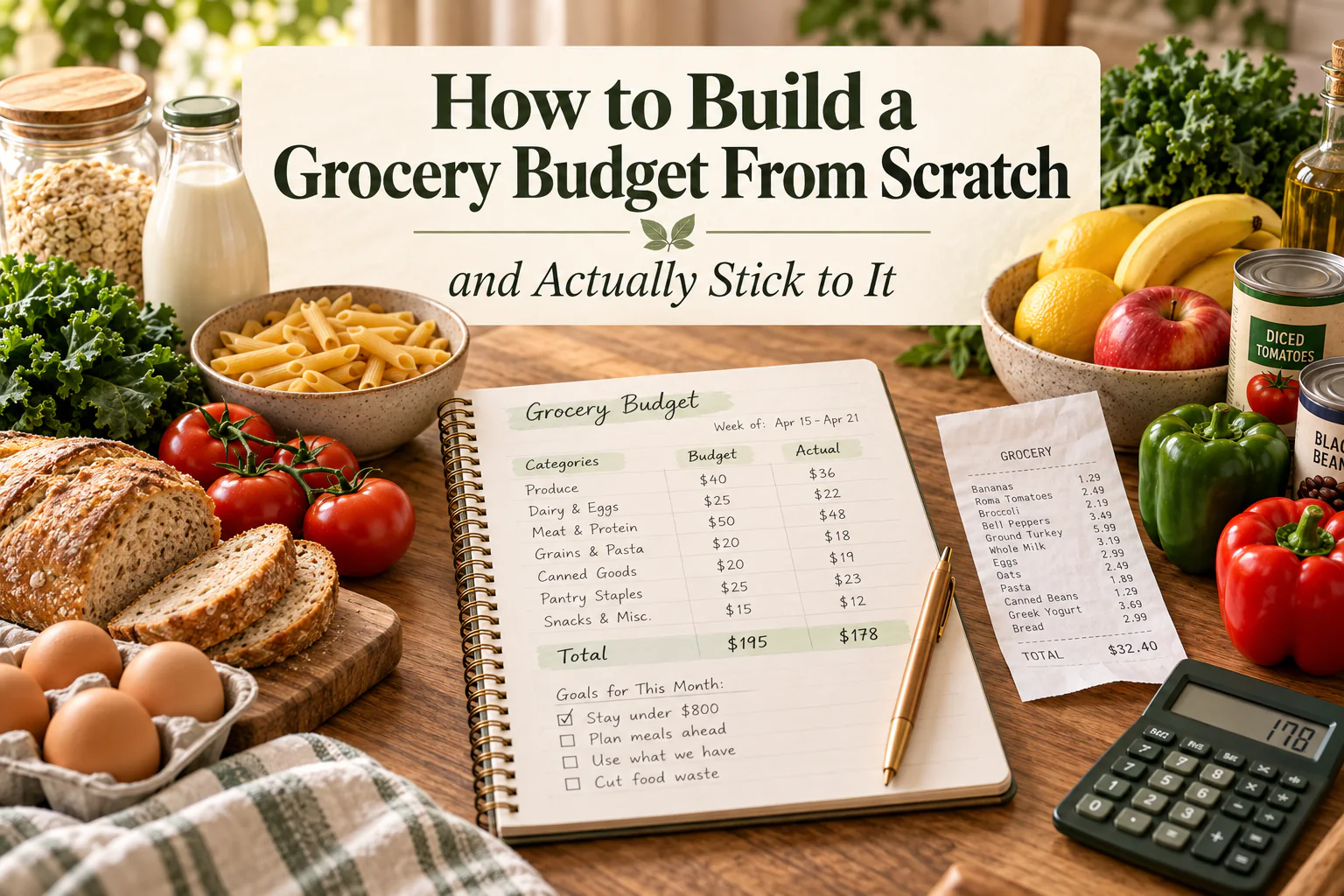
Divide the weekly or monthly amount into buckets. A simple starting split:
| Category | Share |
|---|---|
| Proteins | 30% |
| Produce | 25% |
| Pantry and grains | 20% |
| Dairy and refrigerated | 15% |
| Extras and snacks | 10% |
Adjust the percentages to your household. The point is to know where money is supposed to go, so overspending in one area is visible.
Step 5: Budget by week, not by month
A monthly number is easy to ignore until the last week, when the money is gone. Divide it into weekly amounts. If you shop once a week, that is your cap for the trip. If you shop twice, split it.
For a structure that makes this tangible, see The Envelope Method for Grocery Budgeting (Digital Version).
Step 6: Plan meals before you shop
A meal plan is the strongest budgeting tool you have, because it turns the budget into a list of specific purchases. Without a plan, you buy what looks good and discover on Thursday that you have no dinner.
Start with How to Meal Plan for the Week. Then check what you have at home before you write the list.
Step 7: Use what is on sale, with a rule
Let sales shape your plan, not your list. Look at the weekly flyer or store app first, choose proteins and produce that are discounted, and build dinners around them. How to Meal Plan Around What’s on Sale covers this without needing coupon apps.
Add one rule: only buy a sale item if it is something you would have bought anyway, or something you will definitely use.
Step 8: Track lightly
Detailed tracking quits on you. Instead, check once a week:
- How much did I spend?
- What did I throw away?
- Which category ran over?
Write three lines in a notes app. Over a month, patterns show up on their own.
Step 9: Adjust once a month
At the end of the month, compare the budget to the result. If you overspent in the same category twice, either raise it (and lower another) or plan differently there. A budget is a working estimate. It should change as prices, seasons, and your household change.
A worked example
Suppose a household of four spent about $1,000 a month on groceries over the last three months, which includes about $120 on household items.
- Separate the categories. Food is about $880. Household items are about $120 and move to their own budget.
- Set a target. A 10 percent reduction is about $790 a month, or roughly $183 a week.
- Split the week. About $55 for proteins, $46 for produce, $37 for pantry and grains, $28 for dairy and refrigerated items, and $17 for extras.
- Plan the meals. Choose five dinners, use leftovers for lunches, and check the sales flyer for proteins.
- Review. At the end of week one, the household finds it spent $201. Produce was on target but protein ran $20 over. Next week they choose a cheaper protein for two dinners.
Notice that the budget is not perfect in week one. It is a first draft that improves each week with real information.
Where grocery money usually leaks
If your total is higher than expected, look for these common leaks before cutting food you enjoy.
- Food waste. Many households throw away a meaningful share of what they buy. Produce and leftovers are the main culprits. Cutting Food Waste Without Tracking Anything is a good place to start.
- Extra trips. Each quick “I just need one thing” stop often turns into a larger purchase.
- Convenience items. Pre-cut produce, single-serve snacks, and packaged meals cost much more per serving.
- Name brands everywhere. Switching a few staples to store brands usually saves money with little change in quality.
- Stocking up on sales you do not use. A discount only matters if the food gets eaten.
- Meals with no plan. Unplanned dinners are the most expensive ones, because they lead to takeout or emergency shopping.
Tight budget strategies
When the number really is small, the approach changes.
Build meals on cheap staples. Rice, pasta, oats, beans, lentils, eggs, potatoes, frozen vegetables, and canned tomatoes carry a lot of meals for little money.
Use meat as a flavoring, not the center. Stretch a pound of ground meat with beans, grains, or vegetables.
Cook from scratch where it saves most. Soups, sauces, and grains are cheaper than their packaged versions.
Plan one “free” meal a week. Make a dinner entirely from what is already in the freezer and pantry. See The January Pantry-First Meal Plan.
Buy in season. The Seasonal Produce Budget Guide shows how to shop produce by price.
Frequently asked questions
How much should I spend on groceries? There is no universal number. It depends on household size, location, diet, and income. Start from your baseline and work toward a lower target gradually.
Should I include eating out in the grocery budget? Keep them separate. If you combine them, restaurant spending can hide inside a grocery total that looks healthy.
Is cash better than a card? Cash makes the limit visible, which helps some people. A separate card or a prepaid account for groceries does the same job digitally.
What if prices keep rising? Review the budget more often, monthly or even every two weeks, and adjust categories. Rising prices call for a new plan, not for guilt.
How do I handle special events and holidays? Add a separate line for them. A holiday meal inside a normal grocery budget is what usually causes a month to run over. See The December Grocery Budget System for an example.
Habits that keep a budget working
- Shop with a list, and shop once a week. Fewer trips means fewer impulse buys.
- Eat before you go. A hungry shopper spends more.
- Use up what you have. The “Use It Up” Meal System helps cut waste.
- Cook once, eat twice. Planned leftovers lower the cost of the next meal.
- Compare unit prices, not just shelf prices.
When the budget is not enough
If you have trimmed waste and planned carefully and the number still does not work, the issue may be the price of food in your area, not your habits. Be honest about that. Adjust the budget upward in the places that matter most (protein, produce) and cut from extras and convenience items first.
Make this easier
Turn your plan into a categorized shopping list with the free Grocery List Generator, so what you buy matches what you budgeted.
Your starting plan
- Add up the last three months of grocery spending.
- Decide what counts as groceries.
- Set a target about 10 percent lower.
- Split it into categories and weeks.
- Plan meals before every shop.
- Review once a week and adjust once a month.
A budget you can keep is better than a perfect one you abandon in week two.
Turn the idea into a system.
Keep Reading