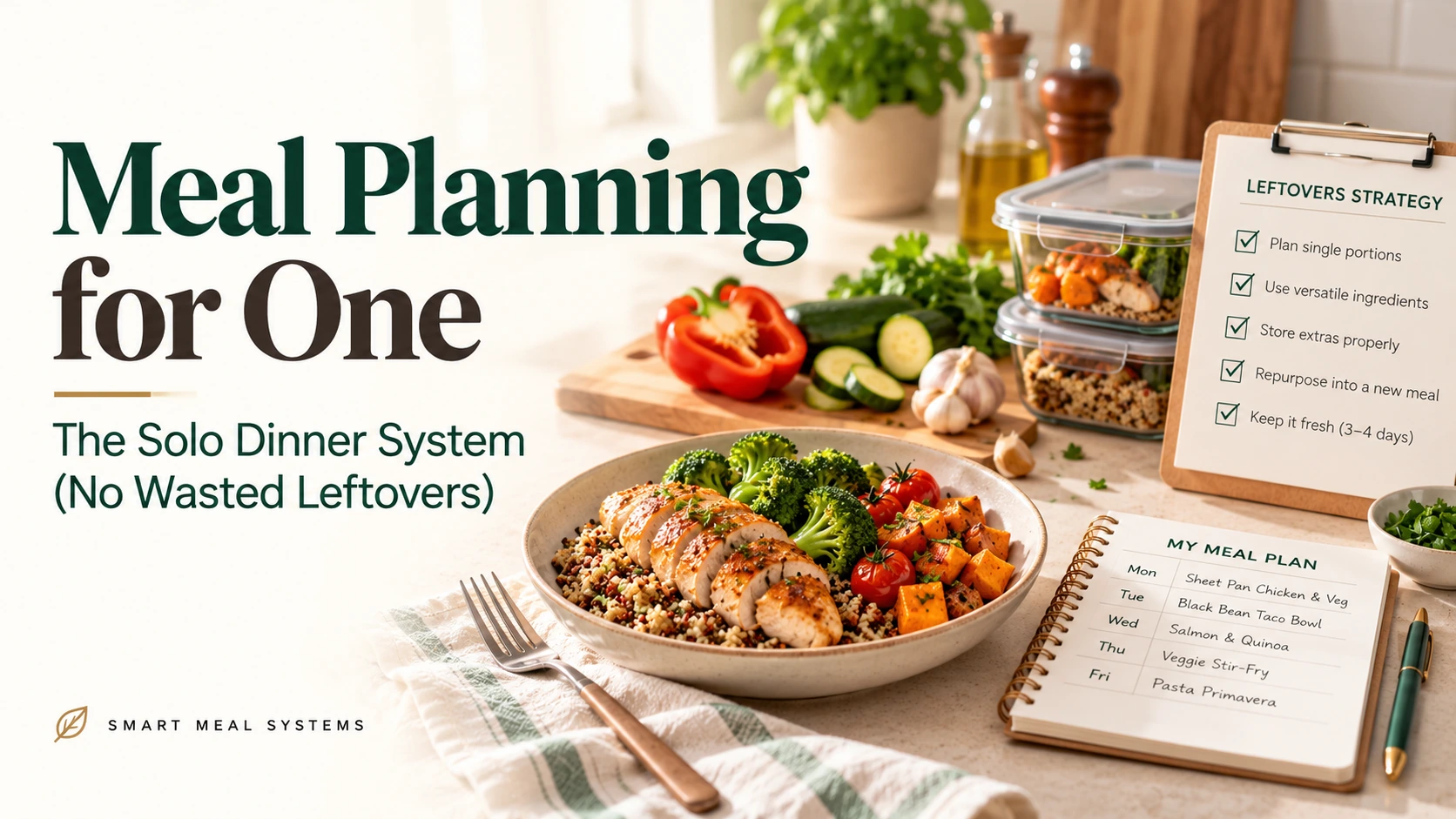
Most meal planning advice is written for families. Recipes serve four to six, grocery lists assume a full household, and “batch cooking” often means a freezer full of food for people who aren’t you.
If you cook for one, that advice leaves you with a fridge full of ingredients that go bad, a week of the same leftovers, or a habit of ordering takeout because cooking for yourself feels like too much effort for too little result.
Cooking for one is a different problem with its own solutions. This guide builds a system around it.
What makes cooking for one hard
The challenges are specific:
- Recipes and packages are too big. A head of cabbage, a bunch of herbs, or a pound of ground meat is more than one person uses before it spoils.
- Motivation. Cooking an elaborate meal for yourself on a Wednesday can feel pointless.
- Variety. Eating the same leftovers for five days is boring.
- Cost per serving. Small portions of fresh food can cost more than family-size ones.
- Waste. It is harder to finish perishable ingredients.
The system below addresses each of these.
Principle 1: Cook once, eat twice (or three times)
For one person, the sweet spot is usually cooking two to four servings and designing the extra portions to be different meals.
- Cook a full recipe and divide it into single portions.
- Eat one or two portions in the next few days.
- Freeze the rest in individual servings.
This turns one cooking session into several “free” dinners later. If you freeze every other batch, you build up a small collection you can rotate through. For the details, see How to Batch Cook: The Complete Guide.
Principle 2: Plan three to four dinners, not seven
You do not need a plan for every night. One person’s week often includes a social dinner, a takeout night, or a leftover night.
A sample structure:
| Night | Plan |
|---|---|
| Monday | Fresh cook: something simple |
| Tuesday | Leftovers from Monday, in a new form |
| Wednesday | Freezer meal |
| Thursday | Fresh cook |
| Friday | Flexible: out or takeout |
| Saturday | Fresh cook or social |
| Sunday | Leftovers or easy meal |
You cook roughly three times and eat well all week.
Principle 3: Shop in small quantities, on purpose
Buying less often saves money, but it also leads to waste if you choose the wrong sizes. Aim for ingredients that work across several meals.
Good for one person:
- Frozen vegetables and frozen fruit (use what you need)
- Eggs
- Canned beans, tomatoes, and tuna
- Rice, pasta, and oats
- Hardy vegetables like carrots, cabbage, and sweet potatoes
- Cheese in blocks
- Tortillas, which freeze well
- Single chicken breasts or thighs, divided from a family pack and frozen
Harder for one person:
- Large bags of fresh greens
- Whole bunches of fresh herbs
- Big containers of dairy
- Whole fresh fish, unless you’ll freeze portions
Use the salad bar, the deli counter, or the bulk section for small amounts of fresh items you will use only once.
Principle 4: Make meals that share ingredients
The trick to variety without waste is overlap. Buy a few ingredients and use them in different ways within the week.
Example:
- A rotisserie chicken or one roasted chicken provides meals for three days: dinner the first night, tacos or wraps on the second, soup or fried rice on the third.
- A bag of spinach appears in an omelet, in pasta, and in a smoothie.
- A pot of rice becomes a bowl, then fried rice, then a burrito filling.
When you plan, write down which ingredient appears in two or more meals. If one doesn’t, consider swapping it.
Principle 5: Keep a strong freezer and pantry
For one person, the freezer is a safety net. It prevents waste and gives you a dinner on days when you don’t want to cook.
Keep on hand:
- single-serving soups and stews you froze earlier
- frozen vegetables
- frozen dumplings or other filling convenience foods
- bread, tortillas, or pitas
- a portion or two of cooked grains
A pantry backbone (pasta, rice, canned tomatoes, beans, broth, oats, and a few sauces) means you can always make something without shopping. Keep an inventory so you don’t buy duplicates. The Free Printable Freezer Inventory Sheet works for this.
Principle 6: Make cooking for yourself feel worth it
One reason people give up cooking for one is that it feels pointless. A few tweaks help.
- Treat yourself like a guest. Use a real plate, sit down, and put your phone away at least for part of the meal.
- Pick one meal a week you really look forward to. Cook it well.
- Keep a few go-to comfort meals that are easy and satisfying.
- Cook with something playing, like music or a podcast.
- Keep it simple. A good dinner can be eggs, toast, and a salad.
A sample week for one
| Day | Dinner | Notes |
|---|---|---|
| Sunday | Sheet-pan chicken thighs and vegetables | Cook 3 thighs, save 2 |
| Monday | Chicken, rice, and the leftover vegetables | No cooking |
| Tuesday | Chicken and cheese quesadilla with salad | Uses the last chicken |
| Wednesday | Frozen soup and toast | From the freezer |
| Thursday | Pasta with jarred sauce, spinach, and an egg | Cook 2 portions, freeze 1 |
| Friday | Out or takeout | Flexible |
| Saturday | Omelet with whatever vegetables remain | Clears the fridge |
Active cooking happens on Sunday and Thursday. Everything else is assembly or reheating.
The grocery list for one
A simple routine works well:
- Check the fridge, freezer, and pantry first.
- Choose three or four dinners.
- Write the list from what is missing.
- Add a short staples line: eggs, milk, bread, fruit.
- Shop once a week, or once every ten days with a mid-week top-up for fresh items.
How to Plan Your Grocery List Around What’s Already in Your Kitchen walks through the pantry check.
Cooking for one on a budget
Shopping for one can cost more per serving, but you can offset it.
- Buy family packs of meat and freeze single portions.
- Choose frozen produce to avoid waste.
- Use the cheaper staples: beans, lentils, eggs, rice, oats.
- Don’t buy a specialty ingredient unless you’ll use it in at least two meals.
- Cook the whole recipe and freeze.
For a framework, see How to Build a Grocery Budget From Scratch.
Avoiding food boredom
Eating the same leftovers repeatedly is the most common reason people quit.
- Change the format. Chili one day, chili on a baked potato the next.
- Change the sauce. A new sauce or spice makes the same base feel different.
- Freeze some and eat the rest fresh.
- Rotate a small list of favorite meals across a month.
The Too-Many-Leftovers Problem has more ways to do this.
Common mistakes
Buying for a family. Follow the single-person list, not the recipe’s ingredient list.
Skipping the freezer. It’s the best tool for one-person households.
Giving up when plans change. Switch to a fallback and move on.
Cooking only on weekends. A midweek mini-session of 20 minutes can keep the week going.
Your first week
- Choose three dinners that share ingredients.
- Cook one to produce two or three servings.
- Freeze one portion.
- Keep one easy fallback meal on hand.
- Write the grocery list from the plan.
Make this easier
Build a short, repeatable week with the free Dinner Rotation Builder, then keep the grocery list tight with the Grocery List Generator.
Cooking for one doesn’t need to be complicated or wasteful. A small plan, a stocked freezer, and a handful of overlapping ingredients can make dinner something you look forward to.
Turn the idea into a system.
Keep Reading