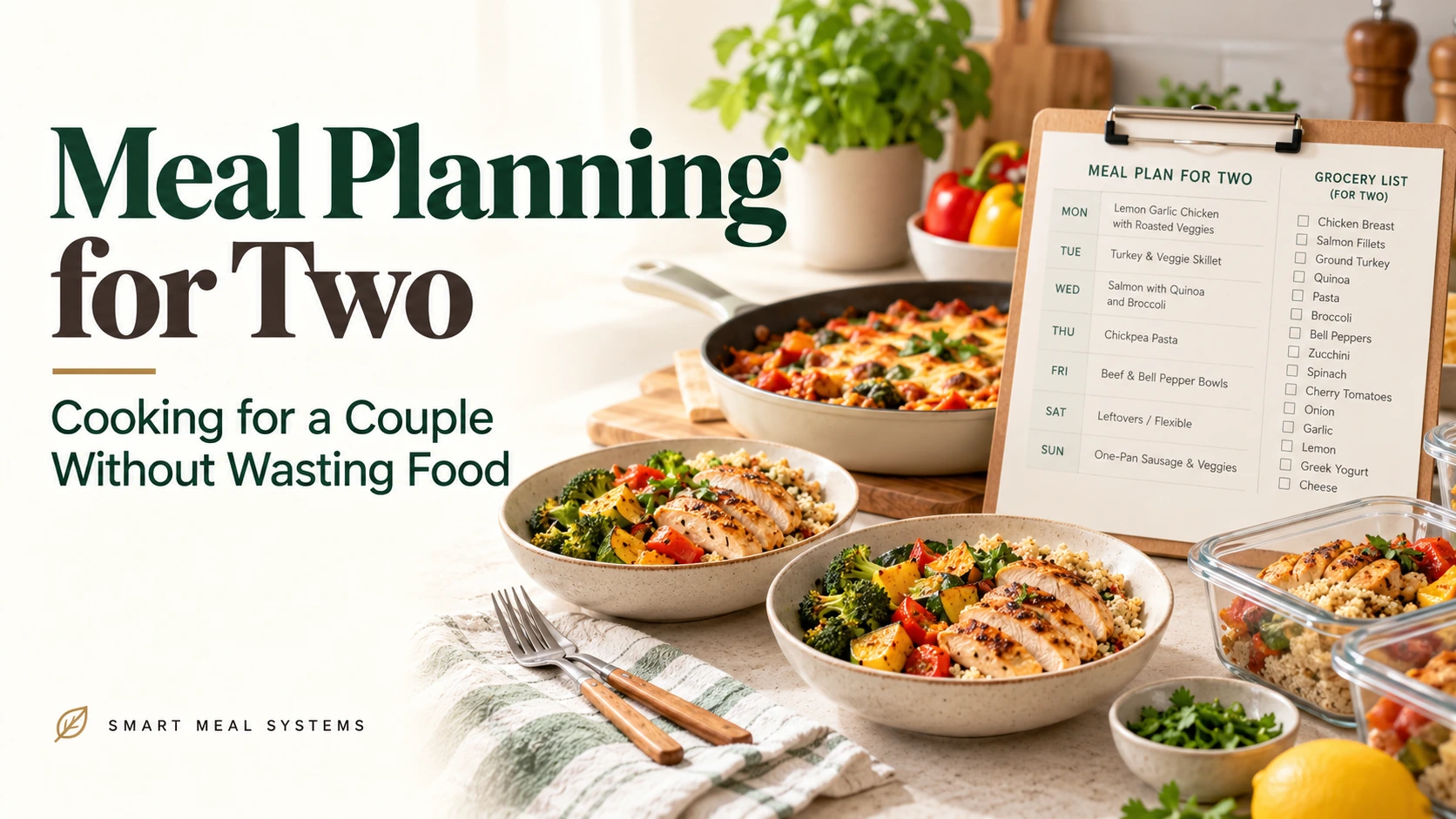
Two people is an awkward number for cooking. Recipes serve four, so you either halve everything and fumble the math, or make the full amount and eat leftovers for days. Grocery packages are sized for families. And you also have to agree on what to eat.
The good news is that two people can be the easiest household to plan for: fewer preferences to juggle, smaller quantities, and a lot of flexibility. This guide shows how to use that.
The challenges of cooking for two
- Recipes are the wrong size. Most serve four to six.
- Produce and meat come in large packages.
- Different schedules and preferences. One of you works late, the other doesn’t like mushrooms.
- Decision fatigue. Two people means two opinions about every dinner.
- Leftover overload. A four-serving recipe becomes two nights of the same dinner.
Every one of these has a straightforward fix.
Step 1: Plan together, but only once a week
The simplest way to avoid daily “what do you want?” conversations is to hold one short planning session each week. Ten minutes is enough.
During it:
- Look at both calendars for the week.
- Mark nights when one or both of you won’t be home.
- Each person picks two dinners they’d like.
- Fill in the rest with easy defaults.
- Make the shopping list together.
When both people contribute, both are more likely to be happy with the plan. And no one is the “default cook” who makes every decision.
Step 2: Use the leftovers on purpose
For two people, a four-serving recipe isn’t a problem. It’s a built-in second meal.
- Cook the full recipe. Eat half tonight.
- Plan the other half for lunch, the next dinner, or the freezer.
- If the recipe is a freezer-friendly dish, freeze the extra as a two-portion meal.
The trick is to decide in advance what the second serving will be, rather than hoping you’ll feel like eating the same dinner again. See The Too-Many-Leftovers Problem for how.
Step 3: Cook two nights, eat four
An efficient pattern for a couple is to cook roughly every other night.
| Night | Plan |
|---|---|
| Monday | Cook: a recipe with 4 servings |
| Tuesday | Leftovers (different form if possible) |
| Wednesday | Cook: another 4-serving recipe |
| Thursday | Leftovers |
| Friday | Takeout or out |
| Saturday | Cook something fun together |
| Sunday | Flexible or freezer meal |
This halves the number of nights anyone needs to cook, without anything feeling like a compromise.
Step 4: Share the work
A planning system isn’t useful if one person does all the work. Some ways to divide it:
- Alternate cooking nights, or split by week.
- One plans and shops, the other cooks.
- Cook together on weekends and split prep.
- Divide the clean-up so the cook doesn’t also wash.
- Rotate who picks the “new recipe” for the week.
Naming who does what removes a silent source of friction.
Step 5: Shop for two
Shopping for two is different from shopping for a family. A few tips:
- Buy smaller packs where you can, or split large ones and freeze half.
- Use the deli, butcher, or bulk sections for exact amounts.
- Choose versatile produce that lasts: carrots, cabbage, onions, sweet potatoes, apples.
- Use frozen vegetables and fruit to avoid spoilage.
- Pick one fresh herb or green to use in several meals, rather than buying five.
- Buy a family pack of meat and freeze it in two-serving portions.
Handling different tastes and schedules
One person doesn’t like an ingredient. Cook it separately or leave it out of one portion. Build-your-own meals like tacos, bowls, and pasta with sauces on the side make this easy.
Different dinner times. Cook a dish that holds well, such as a casserole, soup, or chili, so the second person can reheat it.
Different dietary needs. Use a shared base and different toppings or proteins. For a more detailed approach, see The Vegetarian-Leaning Week.
Different energy levels. Keep an easy-night list that either of you can use without discussion. What to Cook When You’re Too Tired to Decide can help.
A sample week for two
| Day | Dinner | Who | Notes |
|---|---|---|---|
| Sunday | Roast chicken, potatoes, salad | Together | Save the leftovers |
| Monday | Chicken tacos | Partner A | Uses leftover chicken |
| Tuesday | Pasta with vegetables | Partner B | Cook extra, freeze half |
| Wednesday | Leftover pasta, with a fried egg | Whoever | Almost no cooking |
| Thursday | Sheet-pan sausage and vegetables | Partner A | 4 servings |
| Friday | Out | Date night | |
| Saturday | Homemade pizza | Together | Fun project |
Three cooking sessions cover seven nights.
Saving money for two
Two-person households often spend more per serving than larger ones. You can lower it.
- Plan around the store flyer for proteins and produce.
- Cook from staples like beans, rice, eggs, and pasta a few nights a week.
- Don’t buy more fresh produce than you can eat in about five days.
- Freeze bread, tortillas, and cooked grains.
- Use the pantry check before you shop.
See How to Build a Grocery Budget From Scratch for a way to set a target, and How to Meal Plan Around What’s on Sale for stretching it.
Keeping it interesting
With two people, it’s easy to fall into a rut. Some ways to keep it fresh:
- Try one new recipe a week, chosen by whoever’s turn it is.
- Have a theme night: tacos, soup, pizza, breakfast for dinner.
- Cook a cuisine you’ve never made once a month.
- Plan one “project” dinner for the weekend.
Because the quantities are small, a failed experiment isn’t a big loss.
Common mistakes
Making the full recipe with no plan for the extra. Decide ahead what it becomes.
One person doing all the planning. Share it, even if only by choosing two meals each.
Buying family-size packages of perishables. Split and freeze.
Skipping the plan when it’s “just us.” Two people still benefit from not deciding at 6 p.m.
Your first week
- Hold a ten-minute planning session together.
- Choose two cooking nights and plan the leftovers.
- Pick one meal each person is excited about.
- Write the shopping list together.
- Freeze whatever you won’t eat in four days.
Make this easier
Let the free Dinner Rotation Builder set up a rotation around your schedules, then share it on the fridge or your phone.
For the basics behind this routine, read How to Meal Plan for the Week.
Turn the idea into a system.
Keep Reading