Most grocery lists start in the wrong place.
We open a recipe app, choose five dinners, copy every ingredient onto a list, and only later discover that the pantry already held two cans of beans, the freezer had chicken, and three vegetables in the fridge needed using first.
A better grocery list starts inside your kitchen.
The goal is not to avoid buying groceries. It is to make every purchase fill a real gap between what you already own and what you plan to eat.
The kitchen-first grocery formula
Use this order every week:
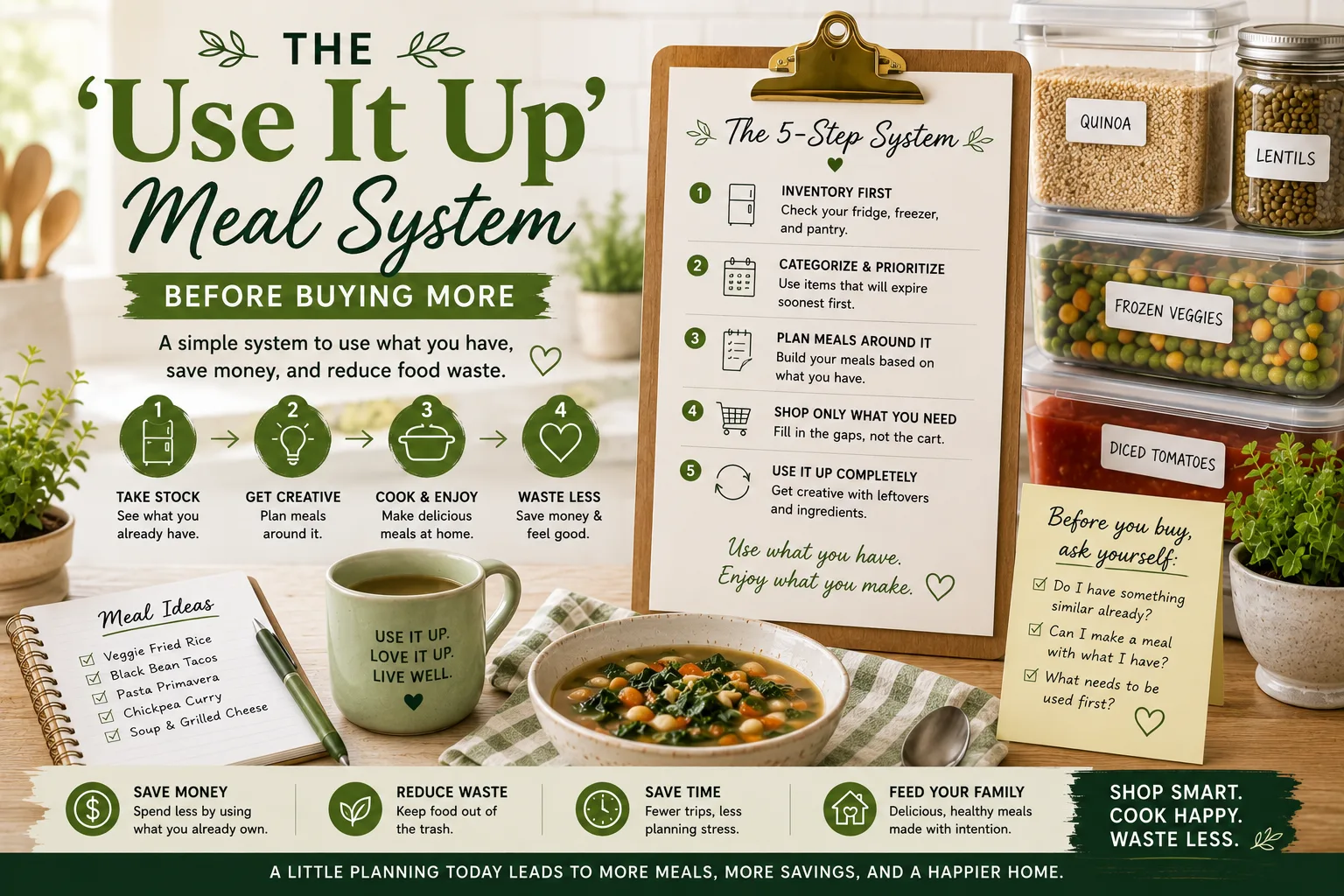
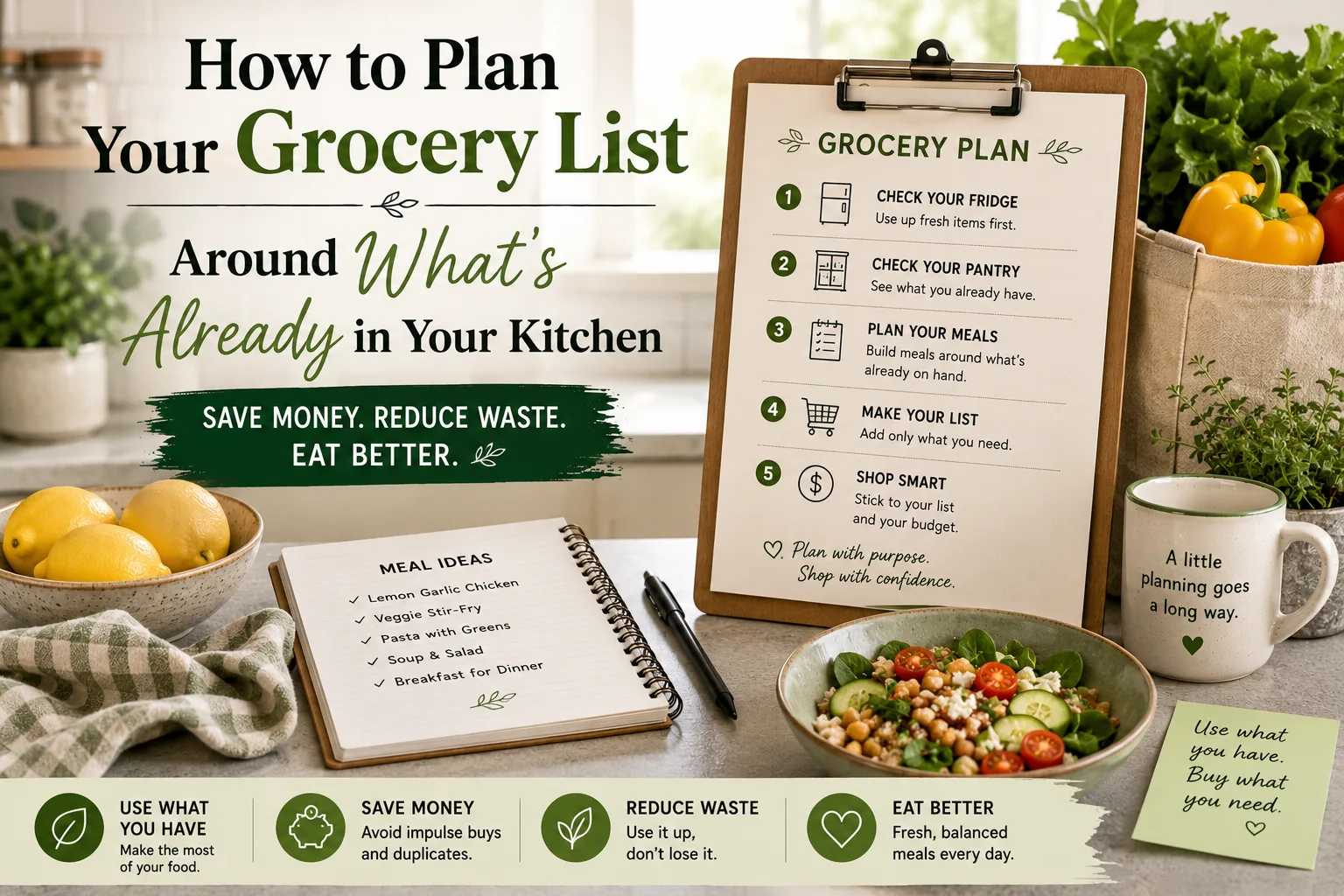
Inventory → Use-First Foods → Meal Anchors → Gap List → Store
That order matters.
If you shop before you inventory, your kitchen becomes storage for duplicate intentions: another bag of rice, another sauce, another frozen vegetable, another ingredient for a recipe you may never make.
Step 1: do a three-zone scan
You do not need a detailed spreadsheet of every ingredient.
Scan three places:
Pantry
Look for meal bases, canned proteins, sauces, grains, open packages, and duplicates.
Refrigerator
Prioritize foods with the shortest life: produce, dairy, cooked leftovers, opened sauces, deli items, and fresh proteins.
Freezer
Look for proteins, frozen vegetables, bread, prepared meals, and portions of leftovers.
Write down only what is useful for the coming week.
A simple note might say:
- chicken thighs;
- 2 cans black beans;
- half bag rice;
- tortillas;
- broccoli;
- 3 carrots;
- frozen peas;
- open jar salsa;
- shredded cheese.
That is enough information to start planning.
Step 2: identify your “use first” ingredients
Not everything you own deserves equal priority.
Choose three to five ingredients that should be used soon.
Usually these are:
- fresh produce beginning to soften;
- opened packages;
- leftovers;
- thawed or older frozen foods;
- ingredients purchased for a previous recipe;
- food taking up space that you genuinely intend to eat.
Circle them.
These become the constraints around which you build the first meals of the week.
For example, if you have broccoli, cooked rice, chicken, and an open sauce, a stir-fry is more useful than choosing a completely unrelated recipe requiring twelve new ingredients.
Step 3: find meal anchors before recipes
A meal anchor is the ingredient that gives you a head start.
Common anchors include:
- a protein already in the freezer;
- a large amount of rice or pasta;
- tortillas;
- a cooked grain;
- a rotisserie chicken;
- beans or lentils;
- vegetables that need using;
- a freezer meal.
Choose three to five anchors, then decide what meals they can become.
Example kitchen inventory
You already have:
- ground turkey;
- pasta;
- canned tomatoes;
- black beans;
- rice;
- frozen corn;
- eggs;
- spinach.
Possible dinners:
- Turkey tomato pasta
- Black bean rice bowls with corn
- Egg and spinach fried rice
- Leftover turkey pasta bowls or soup
Now your grocery list is not “ingredients for four meals.” It is simply the missing pieces.
Step 4: write a gap list
For each planned meal, ask:
What is the minimum I need to buy to turn what I have into dinner?
For the example above, the list might be:
- onion;
- garlic;
- grated cheese;
- lettuce;
- avocado;
- fruit;
- milk;
- bread.
Notice what is missing from the list: turkey, pasta, tomatoes, beans, rice, corn, eggs, and spinach.
You already paid for those foods. The system makes sure they actually become meals.
Step 5: organize the list by store section
Once the gap list is complete, reorganize it into shopping zones:
| Produce | Dairy | Protein | Pantry | Frozen |
|---|---|---|---|---|
| Onion | Milk | Chicken | Bread | Peas |
| Lettuce | Cheese | — | Coffee | — |
| Fruit | Yogurt | — | — | — |
This reduces wandering and impulse additions because the list mirrors the path through the store.
Use the 70/30 grocery rule
A useful target is to let roughly 70% of the coming week’s meals use ingredients you already own, while the remaining purchases add freshness, fill nutritional gaps, or complete meals.
This is not a strict budget rule. Some weeks the ratio will be completely different.
The point is to stop treating your existing food as invisible.
If your freezer is full, the percentage from home should rise. If you are returning from vacation to an empty refrigerator, it will fall.
Build “bridge meals” into the plan
Bridge meals connect several ingredients without demanding a precise recipe.
Good bridge meals include:
- fried rice;
- tacos or wraps;
- grain bowls;
- soup;
- pasta;
- omelets or frittatas;
- sheet-pan dinners;
- quesadillas;
- baked potatoes with toppings.
Suppose you buy cilantro for taco bowls. Instead of letting the remaining bunch wilt, plan a second meal that uses it—perhaps a rice bowl or soup garnish.
That one decision helps groceries flow through the week instead of accumulating as leftovers from recipes.
Do not “shop your pantry” by buying nothing
Pantry-first planning sometimes gets interpreted as a challenge to avoid the grocery store entirely.
That is not the goal.
You should still buy the foods that make existing ingredients useful and meals enjoyable.
If you have pasta and tomatoes but need parmesan and spinach to make the dinner your family will actually eat, buy them.
A $5 completion purchase is often better than ignoring $10 of food because you were trying to create a zero-spend meal.
The duplicate check
Before adding a pantry staple to the list, check its home once.
This is especially useful for:
- rice;
- pasta;
- canned tomatoes;
- beans;
- broth;
- flour;
- sugar;
- oils;
- condiments;
- frozen vegetables.
Do not rely on memory. Pantry staples are exactly the foods people tend to repurchase because they cannot remember whether they have them.
A 10-minute weekly grocery-list routine
Use this sequence before every regular shop:
Minutes 1–3: scan fridge and identify use-first foods.
Minutes 4–5: scan freezer for proteins and ready meals.
Minutes 6–7: scan pantry for meal bases and builders.
Minutes 8–9: choose meals using those anchors.
Minute 10: write only the missing ingredients, then add household staples genuinely running low.
The routine gets faster as your kitchen becomes more organized.
What about sales?
Sales can still be useful—but only after the core list is built.
Ask three questions before adding a sale item:
- Do we regularly eat it?
- Do we have space to store it?
- Will buying it now replace a future full-price purchase?
If yes, add it to backstock. If not, the sale is simply an invitation to spend more.
Your final pre-store check
Before leaving, look at your list and ask:
- Did I check the refrigerator?
- Did I check the freezer?
- Did I check pantry staples?
- Does each dinner use at least one thing we already have?
- Am I buying ingredients that complete meals rather than create new leftovers?
- Have I included breakfast, lunch, snacks, and essentials—not just dinner?
A grocery list should not be a wish list for the week ahead.
It should be the difference between your meal plan and your current kitchen.
Once you start planning that way, you buy with more purpose, use older food sooner, and make meal planning easier because every week begins with ingredients already waiting to become dinner.
Turn the idea into a system.
Keep Reading