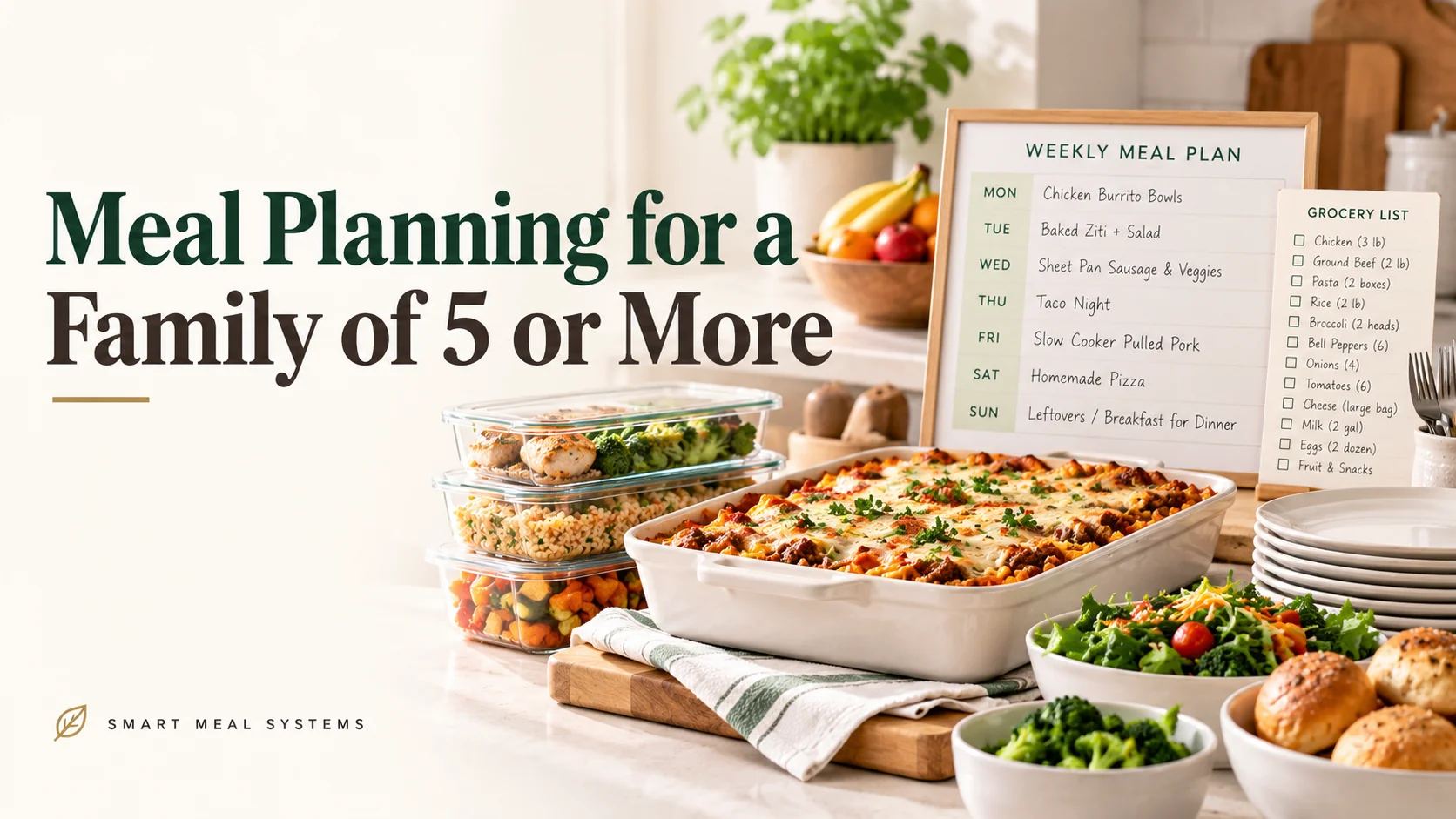
Feeding five, six, or eight people is not the same as feeding four with an extra scoop. Quantities, costs, cooking time, and logistics all change. The grocery bill grows. A “quick” dinner takes longer because everything is bigger. And someone always needs something different.
But a large family also has advantages: bulk cooking is worthwhile, leftovers get used, and there are more hands to help. This guide shows how to plan for a bigger household without letting dinner take over your life.
What changes with a big family
- Quantities. Recipes for four don’t stretch easily.
- Cost. A small price difference per item becomes a big difference per week.
- Equipment. One pan, one pot, or one casserole dish may not be enough.
- Time. More chopping, more cooking, more cleanup.
- Preferences and ages. Toddlers, teens, and adults eat differently.
- Schedules. Several people means several activities.
The strategy is to cook in bulk, simplify the menu, share the work, and plan around the schedule.
Principle 1: Cook in bulk
Large families benefit most from batch cooking, because the extra effort of a double batch is small compared with the time saved.
- Double or triple recipes that freeze well, such as soups, sauces, casseroles, and meatballs.
- Prepare components such as rice, shredded meat, and roasted vegetables for use through the week.
- Use big equipment: a large pot, two sheet pans, and a large slow cooker make a real difference.
How to Batch Cook: The Complete Guide has the methods and storage times, and the 3-3-3 Batch Cooking Method gives a simple structure.
Principle 2: Choose meals that scale
Some meals handle large quantities well; others don’t.
Scale well:
- Pasta dishes and baked pastas
- Tacos, burritos, and build-your-own bowls
- Chili, soup, and stew
- Sheet-pan dinners (use two pans)
- Casseroles
- Slow-cooker meals
- Pizza and sandwiches
Scale poorly:
- Dishes that need to be cooked in batches to order
- Delicate fish or steak for eight
- Recipes that need constant attention
Build your core rotation from the first list.
Principle 3: Use a rotation
For a big family, repeated meals save time and money. A rotation reduces both planning and shopping.
- Choose 10 to 14 dinners your family likes.
- Repeat them on a two-week cycle.
- Keep a master grocery list based on them.
The 2-Week Rotating Dinner Menu explains how to set one up, and the free Dinner Rotation Builder can generate one for you.
Principle 4: Plan around schedules
With many people, the calendar controls dinner. Before you plan, mark each evening’s activities. Then match meals:
| Night type | Meal approach |
|---|---|
| Everyone home | A sit-down meal |
| Staggered schedules | Slow cooker, casserole, or soup that can be served in turns |
| Early activity | Freezer meal or an early assembly dinner |
| Late night | Reheat-and-eat plates left in the fridge |
The easiest meal belongs on the hardest day.
Principle 5: Control the cost
Grocery costs for a big family are a major expense. Some ways to bring them down:
- Buy in bulk where you’ll use it: rice, pasta, oats, beans, frozen vegetables, and meat packs.
- Break down family packs and freeze in meal-size portions.
- Stretch meat with beans, grains, and vegetables.
- Use cheap fillers: rice, potatoes, bread, and pasta.
- Plan around sales and buy extra of staples at low prices if you can store them.
- Compare unit prices, not shelf prices.
- Cook from scratch for the items that cost the most when packaged.
For an overall approach, read How to Build a Grocery Budget From Scratch and Meal Planning on a Tight Budget.
Principle 6: Share the work
A large family is a team, and children and teens can help meaningfully.
- Assign roles. One person sets the table, another handles salad, an older child makes a simple dish.
- Rotate a weekly “dinner helper.”
- Teach a few easy recipes to teens, so they can cook one night a week.
- Make cleanup shared.
- Involve everyone in planning. Each person picks one dinner a month.
Doing this reduces the load and builds skills.
Handling different ages and tastes
Young children. Offer a safe food on the table, such as plain pasta, rice, or fruit, next to the main dish.
Picky eaters. Build-your-own meals help; see The Picky Eater Meal System.
Teens with big appetites. Add an extra side, like bread, rice, or fruit, to fill them up cheaply.
Different diets. Use a base meal and let each person add toppings or sides.
A sample week for a family of six
| Day | Dinner | Notes |
|---|---|---|
| Sunday | Roast chicken (two), potatoes, vegetables | Save meat |
| Monday | Chicken burrito bowls | Uses leftover chicken |
| Tuesday | Slow-cooker chili, cornbread | Double batch, freeze half |
| Wednesday | Baked pasta | Two pans; freeze one |
| Thursday | Tacos | Build-your-own |
| Friday | Pizza night | Everyone helps |
| Saturday | Leftovers and freezer dinners | Clear out |
Three cooking sessions plus a leftover night cover the week.
Make the grocery trip efficient
- Keep a master list that you edit each week.
- Shop once a week with a list and a pantry check first.
- Consider pickup or delivery to save time and avoid impulse buys.
- Keep a well-stocked pantry and freezer for backup meals.
- Store bulk items in labeled bins.
Storage and organization
A big family needs space to store food.
- Use a chest freezer or a well-organized freezer with a written inventory. The Free Printable Freezer Inventory Sheet is helpful.
- Label everything with the name and date.
- Group by type: soups, meats, breakfasts, snacks.
- Store large quantities of staples in clear containers.
Common mistakes
Cooking every meal from scratch. Use shortcuts when you need them.
Scaling a recipe without adjusting time. Larger amounts cook longer.
Overbuying perishables. Plan their use before you buy.
Doing it all alone. Share the load.
Having no backup. Keep freezer and pantry meals ready.
Your first week
- Choose five dinners that scale and that your family likes.
- Double at least two for the freezer.
- Match easy meals to the hardest nights.
- Write the grocery list from a pantry check.
- Give each person a small job.
Make this easier
Set up a two-week rotation that fits your family’s busy nights with the free Dinner Rotation Builder, then build the shopping list with the Grocery List Generator.
A larger family doesn’t have to mean a larger burden. With bulk cooking, a rotation, and shared work, dinner becomes a routine rather than a daily crisis.
Turn the idea into a system.
Keep Reading