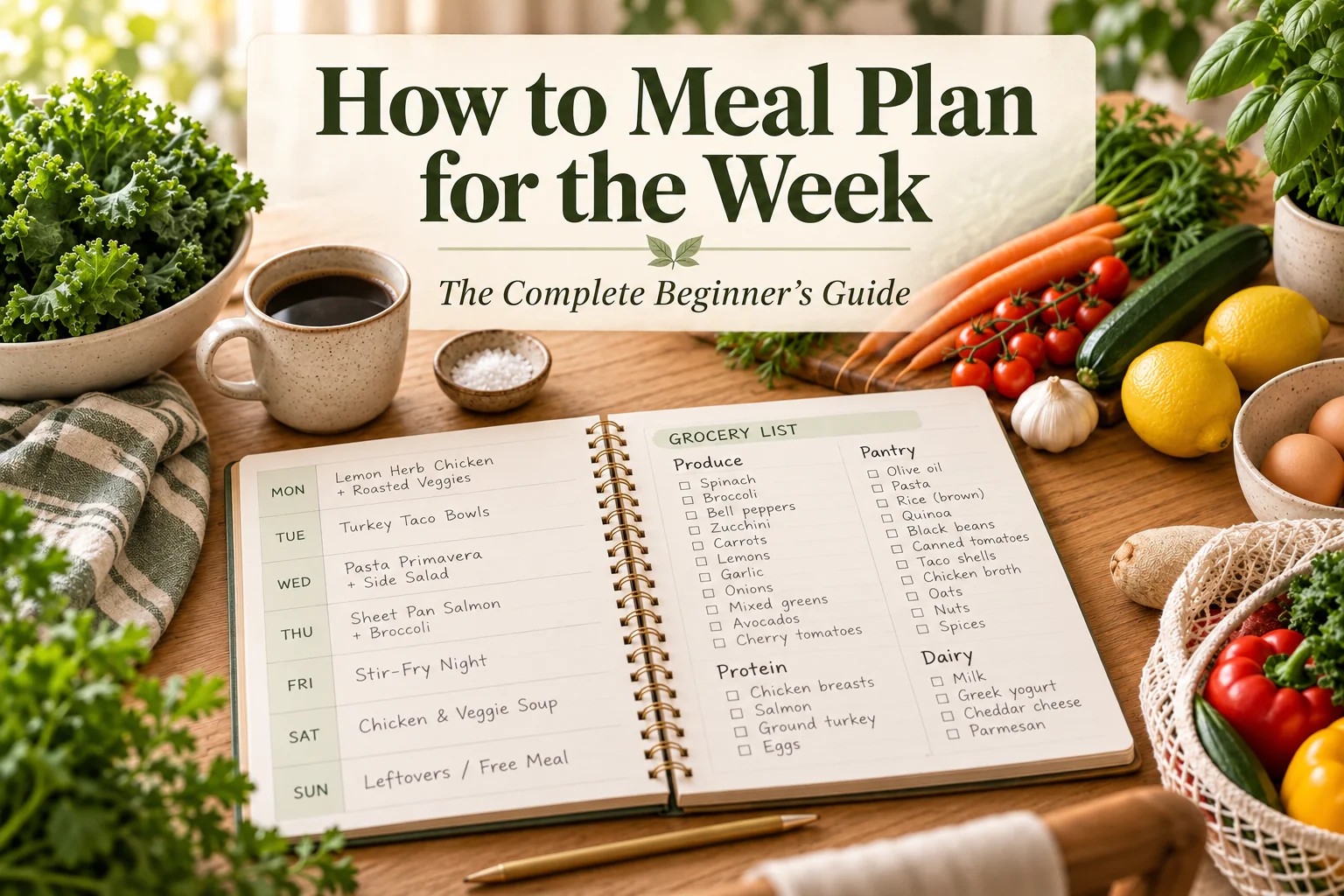
Meal planning sounds like one more thing to manage. In practice, it replaces a daily question (“what are we eating tonight?”) with one short session each week. That trade is the whole point.
This guide walks through the full process from a blank page. It assumes you have never meal planned before, and it keeps the plan small enough to survive a busy week.
What meal planning actually is
A meal plan is a short list of what you intend to eat over the next several days, connected to a grocery list. That is all it needs to be.
It does not need photos, a binder, or a new recipe every night. A plan that says “Monday: tacos, Tuesday: pasta, Wednesday: leftovers” and a list of the ingredients is a complete plan.
Before you plan: look at your real week
Most plans fail because they ignore the calendar. Before choosing a single meal, open your schedule and mark:
- Busy nights: practice, late meetings, appointments, anything that leaves less than 30 minutes for dinner.
- Home nights: evenings with time and energy to cook something more involved.
- Nights you will probably eat out or eat elsewhere. Planning for them is not failure. It keeps you from buying food that spoils.
Now you know how many dinners you really need to plan. For most households it is four or five, not seven.
Step 1: Choose your dinners
Match the effort of the meal to the night.
Busy night: sheet-pan dinner, slow cooker meal, breakfast for dinner, or a freezer meal. Home night: something that needs more attention, such as a roast, a stir-fry, or a new recipe. Leftover night: deliberately scheduled, not an accident.
If you are not sure where to start, begin with meals you already make. Write down five dinners your household reliably eats. You can find a ready-made starting list in 10 Default Dinners You Can Repeat Forever.
Step 2: Check what you already have
Before writing a grocery list, spend five minutes in the fridge, freezer, and pantry. Anything close to its end date should shape a meal this week.
This single habit cuts waste and lowers the grocery bill more than any coupon. If the idea is new to you, How to Plan Your Grocery List Around What’s Already in Your Kitchen covers it in detail.
Step 3: Write the grocery list from the plan
Go meal by meal and list only what is missing. Then group the list by store section (produce, dairy, meat, pantry, frozen) so you walk through the store once.
Add a short “staples” line at the bottom for things you always run out of, like eggs, milk, and bread. Then stop. If it is not on the plan or the staples line, it is not on the list.
Step 4: Put the plan where you will see it
A plan you cannot see does not get followed. Pick one visible spot: the fridge door, a whiteboard, or a note on your phone’s lock screen. Our free weekly meal planning template is built for exactly this.
Step 5: Do a little prep ahead
You do not need a full day of cooking. Fifteen to thirty minutes on the weekend is enough to make the week easier:
- wash and chop vegetables you will use twice
- cook a batch of rice, pasta, or protein
- portion snacks
- thaw tomorrow’s freezer meal
If you want to go further, The Sunday Prep Hour shows a simple version.
Step 6: Plan for the plan to change
Something will change by Wednesday. A swap rule keeps one change from ending the whole plan:
- Too tired? Move a lighter meal forward.
- Missing an ingredient? Swap within the same meal type (one pasta for another).
- Leftovers piling up? Cancel a dinner and eat what you already cooked.
The goal is not to follow the plan perfectly. The goal is to have a plan to adjust.
A sample week, start to finish
Here is what a realistic plan looks like for a household of four with two busy evenings.
| Day | Plan | Why it fits |
|---|---|---|
| Sunday | Roast chicken, potatoes, green beans | More time, and it creates leftovers |
| Monday | Chicken quesadillas with salad | Uses Sunday’s chicken, ready in 15 minutes |
| Tuesday | Slow cooker chili | Busy night: it cooks while you are out |
| Wednesday | Leftover chili over baked potatoes | Zero cooking on a mid-week slump |
| Thursday | Pasta with jarred sauce and frozen vegetables | Busy night, pantry and freezer only |
| Friday | Homemade pizza night | Fun, flexible, and everyone helps |
| Saturday | Flexible: eat out, leftovers, or a wildcard | Margin for real life |
Notice what is happening here. One roast chicken feeds two dinners. One slow-cooker pot feeds two more. The two busiest nights get the two easiest meals. The week has one open slot. None of this needed a new recipe.
The grocery list for this week is short: a whole chicken, potatoes, green beans, tortillas, cheese, salad ingredients, chili ingredients, pasta and sauce, frozen vegetables, and pizza dough or toppings. That is one store trip.
Three ways to write your plan
There is no single correct format. Pick the one that matches how your brain works.
The list. Seven lines, one per day, written on a sticky note or phone. Best for people who want the least friction.
The grid. A weekly planner with rows or columns for each day and meal. Best for visual planners and for families who want everyone to see the plan. A printable like our free weekly planning template is built for this.
The rotation. A fixed set of dinners that repeats every one or two weeks. Best for people who are tired of planning at all. Read The 2-Week Rotating Dinner Menu when you are ready for it.
You can start with a list, move to a grid when you want more detail, and end up on a rotation when you want less work. All three are valid.
What about breakfast, lunch, and snacks?
Start with dinner. It is usually the meal with the most decisions and the most cost. Once dinner is under control, add the others one at a time:
- Breakfast: pick two or three repeats (oatmeal, eggs and toast, yogurt and fruit) and rotate them. There is no need to plan each morning individually.
- Lunch: plan leftovers on purpose. Cook a little extra at dinner and pack it. For school lunches, see Batch-Prep School Lunches for the Whole Week.
- Snacks: keep a short list of grab-and-go options and include them on your grocery list so they do not appear as a surprise expense.
Make the plan fit your household
On a tight budget. Plan around sales, rely on beans, eggs, rice, and frozen vegetables, and use the cheapest protein for two meals. The budget guide goes further.
With picky eaters. Plan meals that can be assembled, such as tacos, bowls, and pasta with sauce on the side. Everyone builds their own plate from the same ingredients.
With very little time. Use only 15-minute meals on weeknights and move anything involved to the weekend. 15-Minute Dinners for the Busiest Weeks has ideas.
With an unpredictable schedule. Plan “ingredients for four dinners” instead of assigning days. Cook whichever fits each evening.
Your weekly planning session
Keep it to about ten minutes, at the same time each week. A reliable order:
- Look at the calendar for the coming week (two minutes).
- Check the fridge, freezer, and pantry (three minutes).
- Choose your dinners and note any leftovers (three minutes).
- Write the grocery list from the plan (two minutes).
Attach it to a habit you already have, such as Sunday coffee or Friday after the kids are in bed. A planning session with a trigger happens. One without a trigger gets postponed.
Common beginner mistakes
Planning seven new recipes. Start with familiar meals and add one new recipe a week.
Planning too far ahead. One week is enough. Plan two weeks once the habit holds.
Ignoring leftovers. Cook once and schedule the second meal.
Skipping the pantry check. This is where most overspending starts.
Giving up after one missed day. A skipped dinner is data, not failure. Adjust and continue.
Frequently asked questions
How far ahead should I plan? One week while you are learning. Many people eventually move to two weeks, which pairs well with a rotation, or plan only the first half of the week and leave the rest flexible.
How many meals should I plan? Fewer than you think. If you will eat out or have leftovers twice a week, plan five dinners, not seven.
What if I do not feel like what the plan says? Swap it for another meal in the plan, or use your fallback. Your plan is a menu you chose when you were rested, so it is allowed to be overruled when you are not.
How long does meal planning take? About ten to twenty minutes a week once you have done it a few times. The first week is slower while you set up your lists.
Do I need an app? No. A notes app, a sticky note, or a printed template is enough. Choose the tool you will actually open.
What if my family does not like the plan? Involve them. Ask each person to name one dinner they would like in the week. People eat more happily from a plan they helped write.
Is meal planning worth it if I only cook a few nights a week? Yes. Planning the nights you do cook, and the leftovers or easy meals around them, still saves money and a lot of mental effort.
Your first week, in one page
- Mark busy, home, and leftover nights on your calendar.
- Pick four or five dinners.
- Check the fridge, freezer, and pantry.
- Write the grocery list from the plan, grouped by store section.
- Post the plan somewhere visible.
- Do 15 to 30 minutes of prep.
That is the entire system. Everything else on this site, from rotations to batch cooking to budgeting, builds on these six steps.
Make this easier
Skip the blank page: build a repeatable week with the free Dinner Rotation Builder, then turn it into a shopping list with the Grocery List Generator.
Where to go next
Once the weekly routine feels natural, the next step is cutting down on the decisions it still takes. The 2-Week Rotating Dinner Menu repeats your best meals so planning takes minutes. If you want a bigger reset, read How to Build Your Own Meal System From Scratch.
Turn the idea into a system.
Keep Reading