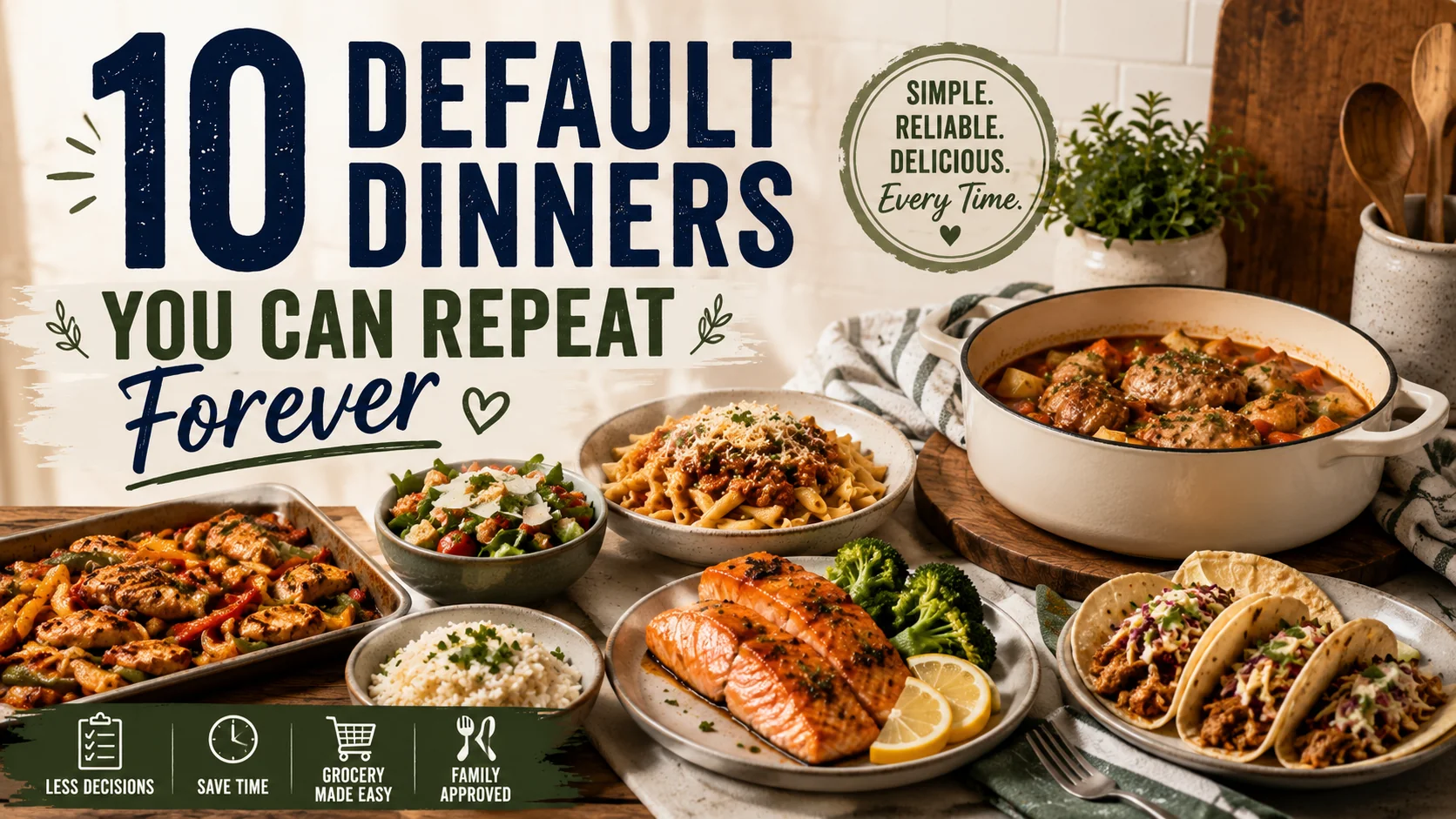
Most weeknight dinner stress does not come from cooking. It starts earlier, with the repeated question: What are we going to eat tonight?
If you answer that question from scratch seven nights a week, you are making more than 350 dinner decisions a year.
A default dinner list removes most of them.
Defaults are not a rigid meal plan. They are ten reliable meal formulas you already know how to shop for, cook, and adjust. When you have energy, try something new. When you do not, choose a default.
The goal is not to eat the exact same plate forever. It is to stop requiring inspiration before you can feed yourself.
What makes a dinner a good default?
A default dinner should pass four tests:
- Your household actually eats it. Aspirational meals do not count.
- The ingredients are easy to find. A default should not require a specialty-store trip.
- You can make it without carefully following a recipe. Familiarity is part of the system.
- It has room for variation. You can change the protein, vegetable, sauce, or side without learning a new meal.
The most useful defaults are formulas rather than recipes.
Here are ten that can cover a surprising number of weeks.
1. Taco night
Formula: protein + tortillas + crunchy vegetable + cheese + sauce.
Use ground beef, chicken, beans, lentils, shredded pork, or leftover roasted meat. Swap flour tortillas for corn tortillas, taco bowls, or even tortilla chips.
Keep salsa and tortillas as regular pantry/freezer items and taco night becomes one of the fastest ways to use leftovers.
2. Pasta + sauce + vegetable
Pasta is a default because it can move in many directions without changing the basic process.
Try marinara with spinach, pesto with peas, tomato sauce with ground turkey, lemon and Parmesan with broccoli, or a simple creamy sauce with mushrooms.
The formula is more important than the recipe:
pasta + one sauce + one vegetable + optional protein.
When the refrigerator is nearly empty, frozen vegetables work perfectly well here.
3. Sheet-pan dinner
Formula: protein + sturdy vegetables + seasoning + high heat.
Chicken thighs with potatoes and carrots, sausage with peppers and onions, or salmon with broccoli all fit the same system.
The advantage is not only easy cooking. Cleanup is predictable too.
Keep one or two favorite seasoning combinations so you do not turn a simple sheet-pan meal into another decision exercise.
4. Rice bowl night
Start with rice, then add a protein, vegetables, and a strong finishing sauce.
A bowl might be:
- rice + chicken + cucumber + carrots + sesame dressing
- rice + black beans + corn + salsa + avocado
- rice + leftover beef + broccoli + teriyaki sauce
- rice + roasted vegetables + chickpeas + tahini
Bowls are especially useful late in the week because small quantities of leftovers suddenly look intentional when served over a base.
5. Soup + something crunchy
Soup becomes more satisfying when you automatically pair it with one contrasting side.
That might be grilled cheese, garlic bread, crackers, quesadillas, or a simple toasted sandwich.
Keep two emergency soups in the pantry or freezer. A default system should include nights when you do not really cook.
Homemade soup is wonderful; it is not a requirement for the system to work.
6. Breakfast for dinner
Eggs are inexpensive, quick, and adaptable.
Use scrambled eggs, omelets, breakfast tacos, pancakes, waffles, or a simple egg-and-potato skillet. Add fruit or a vegetable and dinner is finished.
Breakfast-for-dinner is particularly useful when the meal plan falls apart because many households already keep the core ingredients on hand.
7. Rotisserie chicken night
This is a strategic convenience meal, not a cooking failure.
Pair a store-bought rotisserie chicken with two easy sides: bagged salad and bread, microwave rice and frozen vegetables, baked potatoes and slaw, or tortillas and salsa.
Then deliberately save leftover chicken for tomorrow’s bowls, sandwiches, soup, or tacos.
One purchase can solve more than one dinner.
8. Burger or sandwich night
The formula is filling + bread + crunchy side.
That could mean burgers, chicken sandwiches, grilled cheese, tuna melts, pulled chicken rolls, or veggie burgers.
Serve with salad, raw vegetables, oven fries, fruit, or chips depending on the night.
This category is useful because it scales down beautifully. Cooking for one or two people does not require making a casserole-sized meal.
9. Baked potato bar
Bake potatoes and let the toppings do the work.
Useful toppings include cheese, leftover chili, broccoli, sour cream, beans, shredded chicken, green onions, bacon, salsa, or corn.
A potato bar is also one of the easiest ways to accommodate different preferences without making separate dinners.
Everyone starts with the same base and builds a different plate.
10. Freezer rescue night
This one should be an official default rather than an admission that planning failed.
Once a week or every other week, eat something already in the freezer: frozen dumplings, leftover chili, cooked meatballs, soup, a casserole portion, fish fillets, or a meal you deliberately froze earlier.
Pair it with a vegetable or simple side and call dinner done.
The freezer only saves time if food regularly comes back out of it.
Turn the ten defaults into a weekly system
You do not need to schedule all ten. Pick five to seven that fit your household and assign broad themes to days if that helps.
For example:
| Day | Default |
|---|---|
| Monday | Pasta |
| Tuesday | Tacos |
| Wednesday | Sheet pan |
| Thursday | Bowls |
| Friday | Sandwich/burger |
| Saturday | Flexible/new recipe |
| Sunday | Soup or freezer rescue |
The theme is a decision shortcut, not a rule.
If Tuesday becomes chaotic, freezer rescue can replace tacos. Nothing breaks.
Make this easier
Build your own repeatable dinner rhythm with the free Dinner Rotation Builder. Choose 7 or 14 days, mark the nights that need to be easiest, and save the result on this device.
Keep a permanent default grocery list
Defaults become much more powerful when the ingredients overlap.
A useful core list might include:
- tortillas
- pasta
- rice
- potatoes
- canned beans
- eggs
- shredded cheese
- frozen broccoli
- frozen mixed vegetables
- salsa
- pasta sauce
- bread in the freezer
- one or two proteins
These ingredients can create multiple dinners instead of belonging to one specific recipe.
That reduces food waste and makes grocery shopping easier because you are replenishing a known system rather than designing a new kitchen every week.
Use the 80/20 rule for variety
Repeating dinners does not mean giving up new recipes.
Let roughly 80% of weeknight meals come from familiar systems and use the remaining 20% for experimentation, seasonal cooking, or something you genuinely feel excited to make.
That gives novelty a better role. New recipes become optional enjoyment rather than a nightly obligation.
You can also create variety inside the defaults. Taco night with black beans and avocado feels different from shredded chicken tacos. A Mediterranean rice bowl feels different from a teriyaki bowl even though both use the same structural formula.
Review your defaults every season
Your list is allowed to change.
In winter, soup and slow-cooker meals may appear more often. In summer, sandwiches, salads, grilling, and no-cook meals may take their place.
Every few months, ask:
- Which default do we always enjoy?
- Which one keeps getting skipped?
- Which meal is easy enough that it should be added?
- Which ingredients are we regularly wasting?
Replace weak defaults rather than abandoning the whole system.
The real purpose of a default dinner list
The list is not there to make your meals more disciplined. It is there to preserve your attention for things that matter more than deciding whether Wednesday needs a brand-new chicken recipe.
On a good week, your defaults give you a framework. On a hard week, they give you an answer.
Write ten meals your household already likes. Put the list somewhere visible. Keep the overlapping staples in your kitchen. Then, the next time someone asks, “What’s for dinner?” you do not need inspiration—you need only to pick from a system you already trust.
Turn the idea into a system.
Keep Reading