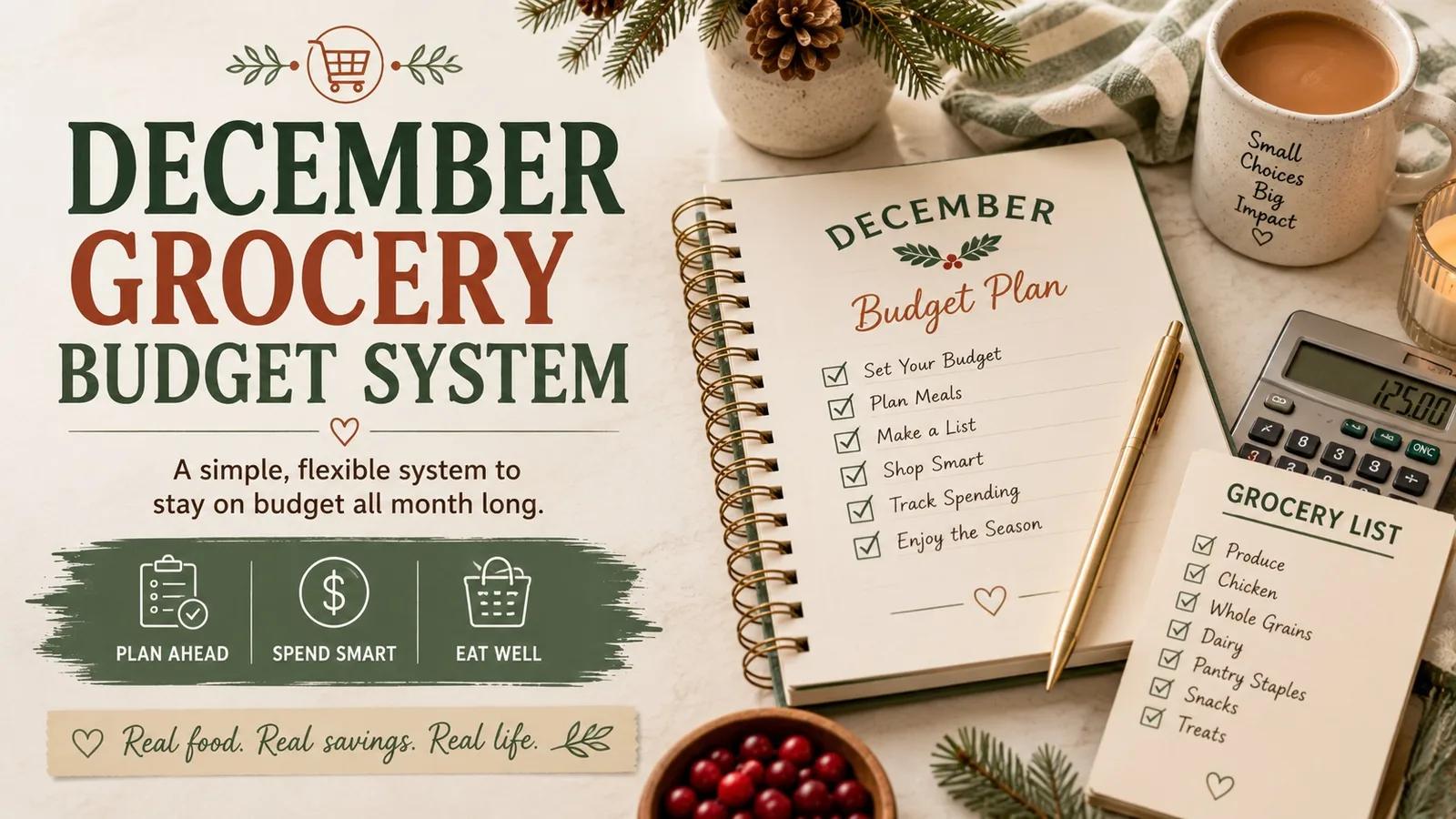
December grocery spending feels unpredictable because three different kinds of food are usually being paid for from the same grocery budget: normal meals, holiday events, and seasonal extras.
When all three live in one number, it is almost impossible to know whether you are actually overspending — or simply asking a normal grocery budget to cover an abnormal month.
The solution is to split December into separate food jobs before you start shopping.
The 3-Bucket December Grocery System
Bucket 1 — Normal meals
Your ordinary breakfasts, lunches, dinners, snacks and staples.
Bucket 2 — Holiday events
Christmas dinner, parties, potlucks, guests, special breakfasts and hosting.
Bucket 3 — Seasonal extras
Baking ingredients, candy, drinks, stocking food, special treats and impulse seasonal purchases.
The total can still be one household food budget. The difference is that now you know what each dollar is supposed to do.
Step 1: Protect the normal-meals budget first
Start with whatever you normally spend on food in a regular month.
Do not cut that number aggressively just because December is expensive elsewhere. That often creates a predictable cycle: you underfund normal dinners, get tired, order takeout, and still spend money on holiday food.
Instead, reduce the complexity of normal meals.
December is a good month for:
- repeat dinners;
- soups and sandwiches;
- pasta nights;
- freezer meals;
- leftovers;
- slow-cooker dinners;
- breakfast for dinner;
- one or two deliberately flexible nights each week.
The goal is not “cheap food all month.” It is low-decision food that keeps ordinary evenings from competing with holiday plans.
Step 2: Count holiday food events before assigning money
Write down every food event you expect to pay for.
Example:
| Event | People | Your responsibility |
|---|---|---|
| Office potluck | 12 | One side dish |
| Family cookie night | 6 | Baking ingredients |
| Christmas Eve | 5 | Full dinner |
| Christmas breakfast | 5 | Breakfast |
| Christmas dinner | 10 | Main + two sides |
Now the holiday bucket has a real workload.
This matters because “holiday groceries” is too vague. A month with one hosted dinner is not the same as a month with five events.
Step 3: Set a cap for each event
Instead of one large holiday-food number, give each event a cap before deciding the menu.
A useful order is:
- set the dollar cap;
- choose the main dish;
- choose sides that fit what remains;
- decide what can be store-bought;
- stop adding food when the role is filled.
Step 4: Give seasonal extras their own ceiling
Seasonal grocery aisles are designed to turn “that looks fun” into twenty small purchases.
A separate extras cap makes those choices visible.
Include things such as:
- specialty hot chocolate;
- candy;
- fancy cheese bought without an event attached;
- extra baking supplies;
- novelty snacks;
- seasonal drinks;
- “just in case guests come” food.
You do not need to eliminate these. You just need to stop pretending they are ordinary groceries.
The weekly December rule: one event, one easy week
When a major holiday event lands in a week, simplify the rest of that week’s meals.
For example:
| Day | Dinner role |
|---|---|
| Monday | soup + bread |
| Tuesday | tacos |
| Wednesday | leftovers |
| Thursday | freezer meal |
| Friday | flexible |
| Saturday | holiday event |
| Sunday | leftovers / reset |
This prevents one expensive event from sitting on top of a normal seven-dinner week.
Use leftovers as planned inventory
Holiday leftovers are only economical if they replace future food purchases.
Before the event, decide what leftovers will become.
- roast chicken → sandwiches or soup
- ham → breakfast, pasta, beans
- vegetables → frittata or bowls
- bread → breakfast casserole
- cheese platter → lunches or pasta
The Leftover Replacement Rule
For every large holiday meal, identify two future meals it can partially replace before you shop.
That changes leftovers from accidental abundance into usable inventory.
Build one “December survival” grocery list
Keep five categories stocked all month:
Fast protein
Eggs, rotisserie chicken, beans, frozen meatballs, canned tuna — whatever your household will actually use.
Fast starch
Pasta, rice, tortillas, bread, potatoes.
Low-prep produce
Frozen vegetables, salad kits, fruit, baby carrots.
Emergency meals
Two freezer dinners or pantry meals requiring almost no thought.
Breakfast basics
Enough simple breakfast food that busy mornings do not trigger convenience spending every day.
The list should make ordinary eating easier while holiday attention goes elsewhere.
A sample December split
Suppose a household normally spends $700 per month on groceries and decides December can rise to $900.
One workable split could be:
| Bucket | Amount |
|---|---|
| Normal meals | $650 |
| Holiday events | $190 |
| Seasonal extras | $60 |
| Total | $900 |
The exact numbers are not universal. The useful part is that every category now has a boundary.
If the Christmas menu grows by $40, you can see what must shrink. Without buckets, that $40 simply disappears into “groceries.”
The mid-month check
Halfway through December, do not ask only “How much have we spent?” Ask:
- How much normal food is left to buy?
- Which holiday events have already been paid for?
- Which events still need shopping?
- How much of the extras bucket remains?
- Do we already have food that can cover an easy dinner week?
That gives you a useful forecast instead of a post-mortem.
What to cut first if the numbers stop working
Cut complexity before quantity.
- Drop a side dish no one specifically cares about.
- Buy one dessert instead of making multiple desserts.
- Replace a cooked appetizer with a cold platter.
- Use an easy normal dinner rather than ordering takeout.
- Stop buying speculative “guest food” without a specific event.
The point of a December grocery budget is not to make the holidays austere. It is to make sure holiday food is chosen deliberately instead of quietly consuming every other food dollar in the month.
Turn the idea into a system.
Keep Reading