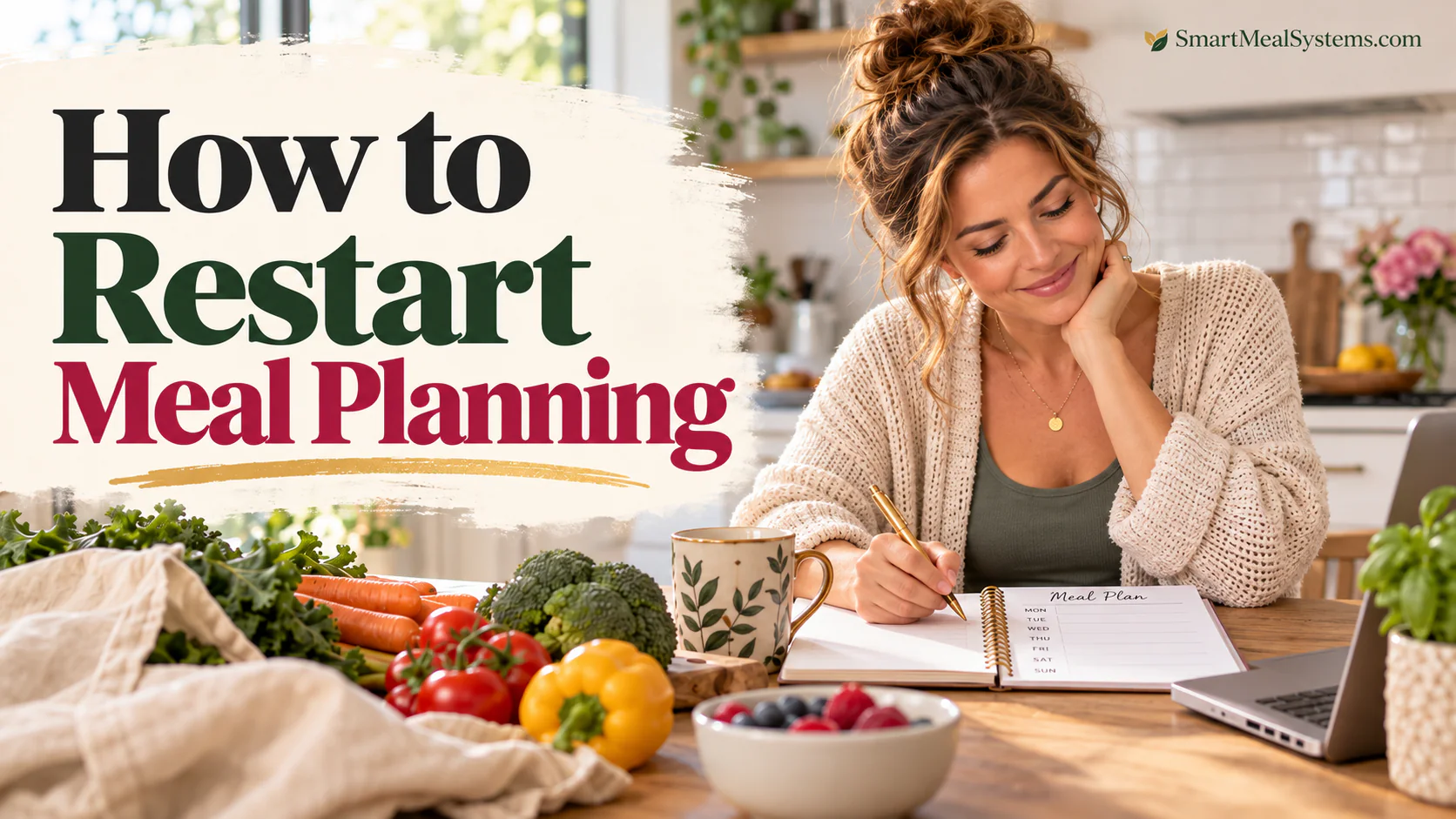
You had a good run. You planned meals, shopped with a list, and dinner mostly took care of itself. Then a busy week, a trip, an illness, or the holidays interrupted it. Now it has been a month, and the idea of starting over feels heavier than the habit ever did.
This is extremely common, and it is not a character flaw. Habits that fit your life are interrupted by life. The skill is not never falling off. It is restarting quickly and without guilt.
Why restarting feels hard
A few things make it feel bigger than it is:
- The all-or-nothing trap. If you can’t do the full system, you do nothing.
- A messy kitchen. The fridge is full of unknowns, and the pantry is a mystery.
- Guilt. You feel you should have kept going, and avoidance grows.
- Starting too big. You imagine rebuilding the whole system at once.
The solution to all four is the same: make the restart much smaller than the original habit.
The principle: restart at the minimum
You do not need to resume where you left off. Start with the smallest version that still helps.
If you used to plan seven dinners, a batch cooking day, a budget tracker, and a detailed grocery list, don’t begin there. Begin with:
- three planned dinners
- a short grocery list
- one fallback meal
That is enough to start the habit again. You can build back up.
The one-week restart plan
Step 1: Do a fridge, freezer, and pantry check
Spend ten minutes seeing what you have. Throw away what has gone off. Pull forward what needs using soon. This clears the mental fog and gives you a starting point. How to Stop Wasting Groceries has a short routine for this.
Step 2: Pick three dinners
Choose three meals you already know how to make and that your household reliably eats. Include at least one that uses something you found in step 1. Skip new recipes this week.
If you need ideas, 10 Default Dinners You Can Repeat Forever is a ready list.
Step 3: Add one fallback
Pick one very easy meal to keep ingredients for: pasta and sauce, eggs and toast, or a frozen pizza. This is your net for the night everything falls apart. What to Cook When You’re Too Tired to Decide can help you choose.
Step 4: Write a short grocery list
List only what the three dinners and the fallback require, minus what you already have. Group by store section. Add the staples you’ve run out of. Stop there.
Step 5: Make the plan visible
Write the three dinners on a sticky note and put it on the fridge. This is all the “system” you need for the first week.
Step 6: Review on day seven
At the end of the week, ask three questions:
- Which meals did we actually make?
- What got in the way?
- What do we want to change?
Adjust one thing for next week. That’s it.
Week two and beyond
Once the first week works, add a little at a time. Do not add everything at once.
| Week | Add |
|---|---|
| 2 | A fourth and fifth dinner |
| 3 | A weekly planning session at a fixed time |
| 4 | A master grocery list or a prepped component (like a pot of rice) |
| 5 and later | A rotation, batch cooking, or budget tracking, as you want |
At any point, if life gets busy, drop back a step. That’s allowed.
What got you off track?
It helps to know why it stopped, so you can build a weak spot into the plan.
You got busy. Make the restart smaller and use more freezer and assembly meals.
You got sick or burned out. Start with defaults and fallback meals only, and be gentle with yourself.
You went on vacation or had guests. Restart with a pantry check and a short plan on your first day back.
The plan got boring. Add variety through sauces, toppings, or one wildcard night. A rotation with a few new meals can help.
It took too long. Cut the planning session to ten minutes. See How to Meal Plan for the Week for a short version.
It cost too much or felt wasteful. Revisit the budget with How to Build a Grocery Budget From Scratch.
Make the habit resilient
Small design changes make the habit survive interruptions.
- Tie it to something that already happens. Plan while you have Sunday coffee, or after the kids go to bed on Friday.
- Keep a “minimum plan” ready. Decide now what your three-dinner version is, so you can restart at once.
- Keep emergency meals stocked. Frozen food and pantry staples catch you on bad weeks.
- Allow skipped weeks. Skipping one is not quitting. You just pick it back up.
- Plan a regular reset. Once a month, spend ten minutes checking the fridge, pantry, and freezer.
When the problem is bigger than the plan
Sometimes a lapse is a sign that life is heavy right now: a new baby, a job change, a health issue, caregiving. In those seasons, a very small plan, or none at all, is the right plan. Lean on easy meals, ask for help, and use the system only where it reduces stress. Starting again when things settle is perfectly fine.
What to say to yourself
It is easy to treat a lapse as evidence that you are not organized. A more accurate way to think about it:
- The system helped when you used it.
- You stopped when life changed.
- You can start again with a smaller version.
Nothing was lost except a few weeks.
A checklist to restart today
- Check the fridge, freezer, and pantry.
- Pick three dinners you already know.
- Choose one fallback meal.
- Write a short grocery list.
- Put the plan on the fridge.
- Review in a week and change one thing.
Make this easier
If starting from a blank page is the hard part, the free Dinner Rotation Builder will generate a plan for you in a few minutes, and you can change anything you don’t like.
The fastest way back is a small step today. Plan three dinners, and the rest comes back more easily than you expect.
Turn the idea into a system.
Keep Reading