Batch cooking only saves time and money if the food is still good when you get to it. The question that comes up again and again is: how long can I keep this?
This post gives you a clear reference chart for cooked meals, plus the habits that make the numbers hold true: cooling food quickly, storing it properly, and reheating it safely.
Note: the times below are general guidelines for home-cooked food based on common food-safety recommendations, such as those from the USDA and FoodSafety.gov. They are not a guarantee. When in doubt, check an official source, and when food looks, smells, or feels off, throw it out.
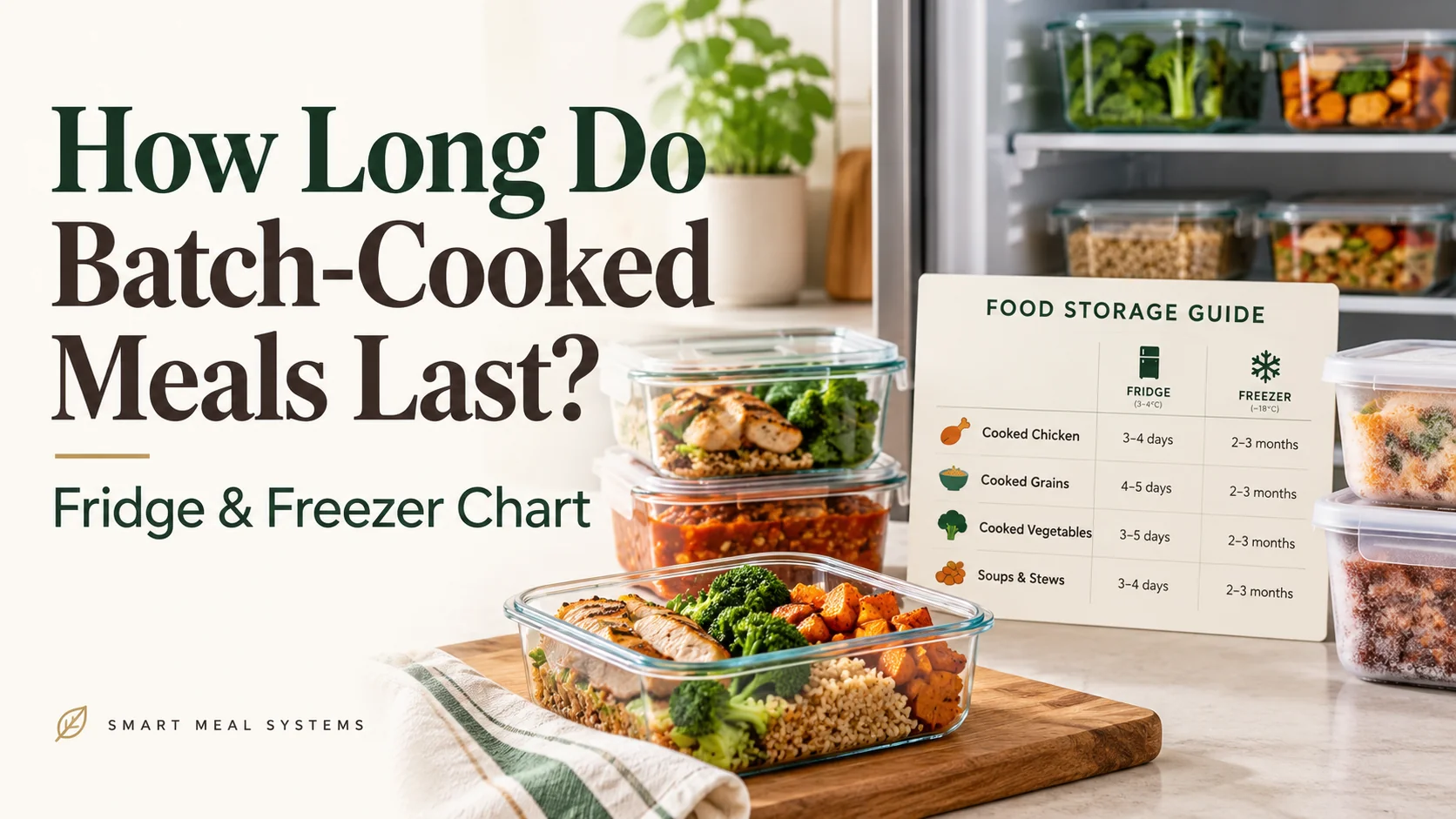
The quick chart
| Food | Fridge (40°F or below) | Freezer (0°F) for best quality |
|---|---|---|
| Soups and stews | 3 to 4 days | 2 to 3 months |
| Chili | 3 to 4 days | 2 to 3 months |
| Cooked chicken, turkey, and other poultry | 3 to 4 days | 2 to 4 months |
| Cooked beef, pork, and lamb | 3 to 4 days | 2 to 3 months |
| Cooked fish and seafood | 3 to 4 days | 2 to 3 months |
| Ground meat dishes (cooked) | 3 to 4 days | 2 to 3 months |
| Meatballs in sauce | 3 to 4 days | 2 to 3 months |
| Casseroles | 3 to 4 days | 2 to 3 months |
| Cooked pasta (plain or sauced) | 3 to 5 days | 1 to 2 months |
| Cooked rice and grains | 3 to 4 days | 1 to 2 months |
| Cooked beans and lentils | 3 to 5 days | 2 to 3 months |
| Pasta sauce (tomato-based) | 3 to 5 days | 3 months |
| Roasted vegetables | 3 to 4 days | 2 to 3 months |
| Egg dishes (frittata, egg muffins) | 3 to 4 days | 2 to 3 months |
| Burritos and wraps | 3 to 4 days | 2 to 3 months |
| Breakfast sandwiches | 3 to 4 days | 1 to 2 months |
| Pancakes and waffles | 3 to 4 days | 2 to 3 months |
| Muffins and baked goods | 3 to 5 days | 2 to 3 months |
| Cooked bacon or sausage | 4 to 7 days | 1 to 2 months |
Key point: the fridge window is short. If you won’t eat it within about four days, freeze it on day one.
What “best quality” means
Food kept at 0°F is generally considered safe indefinitely, but flavor, texture, and moisture decline. The freezer times above show how long food usually stays enjoyable. Beyond that, it may still be safe to eat but taste worse (dry, tough, freezer-burned).
The safe-handling habits behind the chart
The chart assumes you handle food correctly. These steps matter as much as the numbers.
Cool food quickly
Don’t leave cooked food sitting out. A common guideline is to refrigerate or freeze within two hours of cooking, or within one hour if it’s very hot out.
- Divide large batches into shallow containers so they cool faster.
- Don’t put a giant hot pot straight into the fridge; split it up first.
- Use an ice bath for soups if you need to cool them quickly.
Store in the right containers
- Use airtight containers or freezer bags.
- Leave a little headspace for liquids that expand when frozen.
- Squeeze air out of bags to protect against freezer burn.
- Freeze flat for faster freezing and thawing.
Label everything
Write the name and the date you cooked it. A strip of masking tape and a marker is enough. The date is the most important part, because “I think I made this last week” is a risky guess.
Keep the fridge cold enough
Your refrigerator should be at 40°F or below, and your freezer at 0°F. A cheap appliance thermometer helps you check.
Thawing safely
Use one of the safe methods:
- In the refrigerator (the safest, though it takes planning)
- In cold water, changing the water regularly, for small items you’ll cook right away
- In the microwave, if you’ll cook the food immediately afterward
Don’t thaw on the counter. Once food is thawed in the fridge, it can generally be kept a day or two before cooking or eating, depending on the food. For full details, see The Freezer Meal Planner.
Reheating safely
Reheat leftovers until they are steaming hot all the way through. Food safety guidelines commonly recommend an internal temperature of 165°F. A few tips:
- Stir food halfway through microwave reheating to avoid cold spots.
- Reheat only the portion you’ll eat, not the entire batch repeatedly.
- Don’t reheat the same food multiple times.
- Add a splash of water or broth to keep food moist.
Special notes on tricky foods
Rice. Cooked rice can carry bacteria that survive cooking and multiply at room temperature. Cool it quickly, refrigerate it promptly, and don’t leave it out for long.
Seafood. It has a shorter shelf life than most proteins. Plan to eat it first.
Dairy-based sauces. Cream and cheese sauces can separate when frozen. They’re safe but may change in texture. Stir while reheating, or add the dairy fresh.
Raw marinated meat. Freeze it right away. See the Make-Ahead Marinade System.
Cooked pasta. It can go soft when frozen and reheated. Undercook it slightly if you plan to freeze it.
Leftovers in general. Don’t rely on the “sniff test” alone. Food can be unsafe without smelling bad.
How to tell when food has gone bad
Signs to watch for:
- A sour or off smell
- Visible mold
- Slimy texture
- Unusual color
- Bulging or leaking containers
If you’re unsure, throw it out. The cost of a meal is far less than the cost of getting sick.
Use the chart in your weekly routine
You can build the chart into your habits.
- Day 1: cook, cool, portion.
- Days 1 to 4: eat from the fridge, oldest first.
- Day 1: freeze anything you won’t get to in four days.
- Weekly: check the fridge and freezer. How to Stop Wasting Groceries has a quick routine.
- Monthly: check your freezer inventory and use or toss anything past its best time.
The Free Printable Freezer Inventory Sheet and the 3-Column Freezer Rotation System help you keep track.
A fridge-door cheat sheet
You can copy this simple version and tape it inside a cabinet or to the fridge.
- Fridge: eat within 3 to 4 days.
- Not sure you’ll eat it? Freeze it on day 1.
- Freezer: aim to eat within 2 to 3 months.
- Reheat to steaming hot (165°F).
- When in doubt, throw it out.
Common mistakes
Leaving food out too long before storing it. Cool and chill promptly.
Keeping leftovers “just one more day.” Stick to the window.
Not labeling. You won’t remember.
Refreezing thawed food repeatedly. Quality declines and handling risk rises.
Overfilling the fridge. Cold air needs to circulate.
The short version
Most cooked food keeps for three to four days in the fridge and two to three months in the freezer at best quality. Cool it fast, label it, freeze early, and reheat until steaming. For the full batch cooking process, read How to Batch Cook: The Complete Guide.
Make this easier
Plan the dinners you’ll make from your batch-cooked food with the free Dinner Rotation Builder, so nothing sits in the fridge past its window.
Turn the idea into a system.
Keep Reading