Most meal planning advice assumes you enjoy being in the kitchen. If you do not, it can feel like someone is asking you to spend more time at a task you already dread.
The good news is that meal planning is one of the best things you can do when you dislike cooking. A plan does not make you cook more. It lets you cook less, with less stress. This guide shows how to build a plan around your dislike instead of fighting it.
Why you dislike cooking matters
“I hate cooking” can mean several different things, and the fix depends on which one is yours.
| What bothers you | What helps |
|---|---|
| Deciding what to make | Defaults, themes, and rotations |
| Standing at the stove | Slow cooker, sheet pan, no-cook meals |
| Cleaning up | One-pot and sheet-pan meals, fewer dishes |
| Getting home and starting from scratch | Batch cooking and prep ahead |
| Not knowing what to buy | A repeating grocery list |
| The time cooking takes | 15-minute meals and assembly dinners |
Pick the row that sounds most like you and build your plan around that. You do not have to fix everything at once.
Principle 1: Assemble, don’t cook
Many dinners can be put together instead of cooked. These count as meals, and they are not a failure.
- Rotisserie chicken with bagged salad and bread
- Bean-and-cheese quesadillas with salsa
- Grain bowls built from pre-cooked rice, canned beans, and chopped vegetables
- Sandwich or wrap night with fruit and raw vegetables
- A snack plate: cheese, crackers, hummus, fruit, cut vegetables
- Pasta with jarred sauce and frozen vegetables
A good rule: if three or four of your five weeknight dinners are assembly meals, you have made cooking optional for most of the week.
Principle 2: Cook rarely, in bulk
If you dislike cooking, you probably dislike the daily repetition more than any single task. One longer session can replace five short ones.
Pick one day to cook for an hour or two. Make a pot of something (chili, soup, pasta sauce), a tray of roasted vegetables, and a batch of rice or shredded chicken. Then eat from those through the week.
Our complete batch cooking guide shows exactly how to do this, and The Sunday Prep Hour offers a shorter version.
Principle 3: Choose the least-effort method for each meal
For each dinner, ask which method needs the least attention.
- Slow cooker: you start it in the morning and ignore it. Good for chili, shredded meat, soups.
- Sheet pan: everything goes on one pan in the oven. Good for sausage and vegetables, chicken thighs, salmon.
- One pot: one pot for the whole meal, one pot to clean. Good for pasta, rice dishes, soups.
- Sandwich or wrap: minimal heat or none.
- Frozen backup: a freezer meal you made earlier.
For hot weather, How to Batch Cook Without Turning On Your Oven has no-oven options.
Principle 4: Repeat meals shamelessly
People who enjoy cooking often like novelty. You do not have to. Eating the same ten or twelve dinners on rotation is a perfectly good plan.
Write down a list of meals you can make with little thought, and repeat them. Repetition also means you will need fewer recipes and shorter grocery lists. A fixed rotation reduces the amount of thinking you do each week to almost nothing. See The 2-Week Rotating Dinner Menu for how this works.
Principle 5: Lower the standard for what counts as dinner
A lot of the dread around cooking comes from an imagined idea of what dinner is supposed to be: a main, two sides, and everything homemade. That standard is optional.
A decent dinner can be:
- eggs, toast, and fruit
- soup and a grilled cheese
- tacos with store-bought toppings
- frozen dumplings and steamed vegetables
- a protein, a vegetable, and a grain, assembled in any order
If dinner is nourishing and gets eaten, it did its job.
A sample week for someone who hates cooking
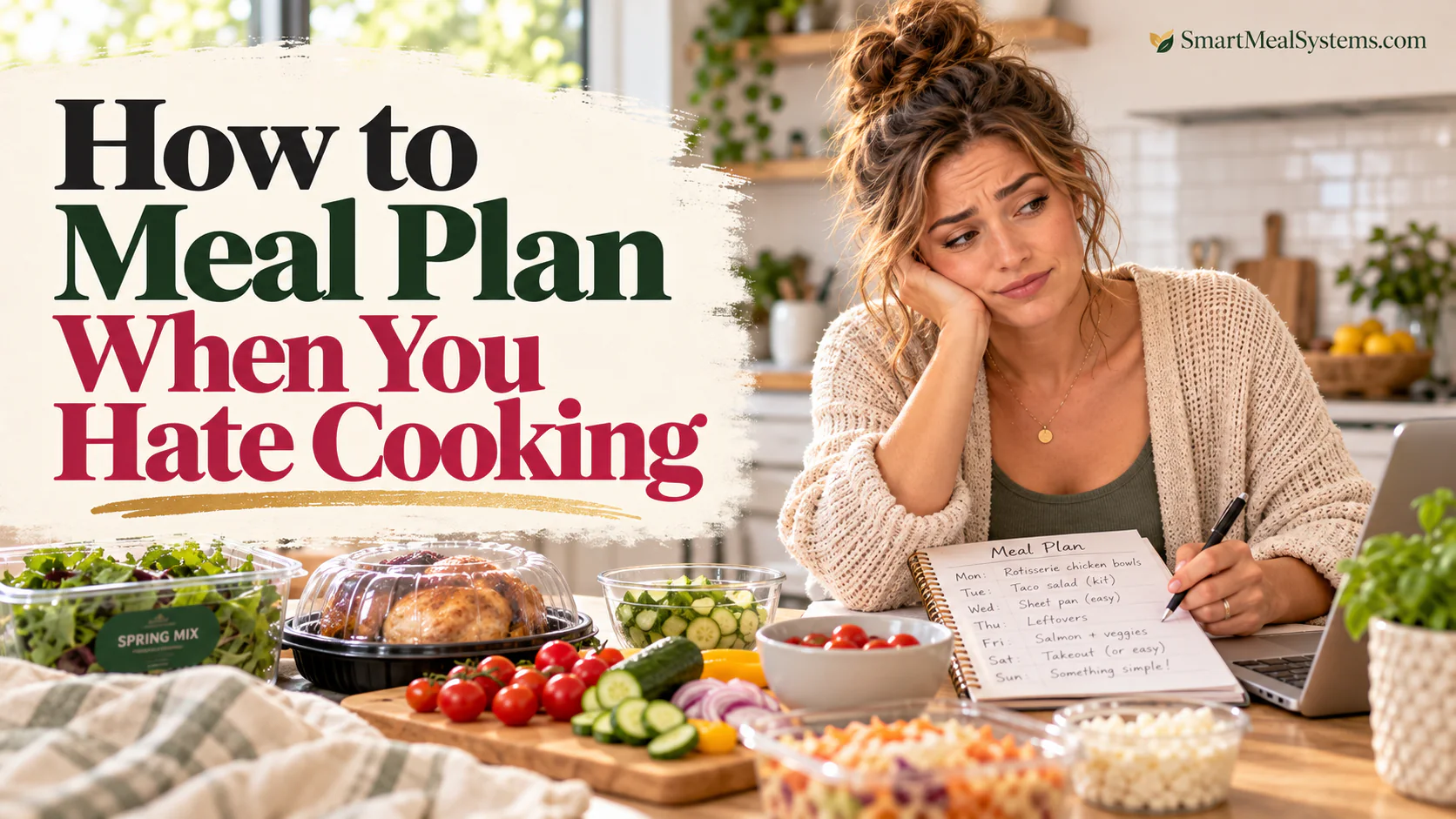
| Day | Dinner | Effort |
|---|---|---|
| Monday | Quesadillas with salsa and bagged salad | 15 minutes |
| Tuesday | Slow-cooker chili (started in the morning) | 10 minutes of prep |
| Wednesday | Leftover chili on baked potatoes | 5 minutes |
| Thursday | Pasta with jarred sauce and frozen broccoli | 15 minutes |
| Friday | Frozen pizza and a salad | 5 minutes |
| Saturday | Rotisserie chicken, bagged salad, rolls | 5 minutes |
| Sunday | Sheet-pan sausage and vegetables | 10 minutes of prep |
Active time across the week is about 75 minutes. Three of the seven nights require essentially no cooking.
The grocery side
Disliking cooking often goes with disliking shopping too. Make it as automatic as you can.
- Keep a master grocery list of the items you buy most. Each week, cross off what you already have.
- Group the list by store section so you walk through once.
- Consider grocery pickup or delivery for the weeks you do not want to walk the aisles.
- Keep a pantry backbone stocked: pasta, rice, canned beans, canned tomatoes, broth, and frozen vegetables.
With that backbone, you can always make something without a special trip.
Cutting down the cleanup
For many people the dishes are the real problem. These help:
- Line sheet pans with parchment or foil.
- Cook in one pot or pan whenever you can.
- Use disposable or reusable containers for prepped food.
- Clean as you go, only a little, so the pile never grows.
- Rinse and load the dishwasher right after eating, before you sit down.
When you really, truly cannot
Some weeks are not going to happen. On those weeks, lean on the system’s fallback:
- Use frozen meals you made earlier.
- Order takeout on a planned night so it stays inside the budget.
- Rely on assembly meals for the whole week.
Planning for takeout is better than avoiding the plan. If you decide in advance that Friday is takeout night, it is no longer a failure. It is part of the plan.
Where to start
You do not need to overhaul your kitchen habits. Try this first week:
- Choose five assembly or low-effort dinners from the list above.
- Pick one meal to start in the slow cooker or oven.
- Keep two fallback meals in the freezer or pantry.
- Write the grocery list from the plan and pick up only what is on it.
The best meal plan for someone who dislikes cooking is not the one with the most variety. It is the one that asks the least of you on the nights you have the least to give.
Make this easier
Use the free Dinner Rotation Builder to set up a repeating plan, and mark your busiest nights so they get the easiest meals.
For the broader system, read How to Stop Deciding What’s for Dinner.
Turn the idea into a system.
Keep Reading