January meal planning often starts with the assumption that a new year needs new food.
New recipes. New habits. New lunches. New breakfasts. A completely new dinner routine.
That sounds fresh for about two weeks. Then the recipe tabs pile up, groceries get expensive, and dinner becomes another daily decision.
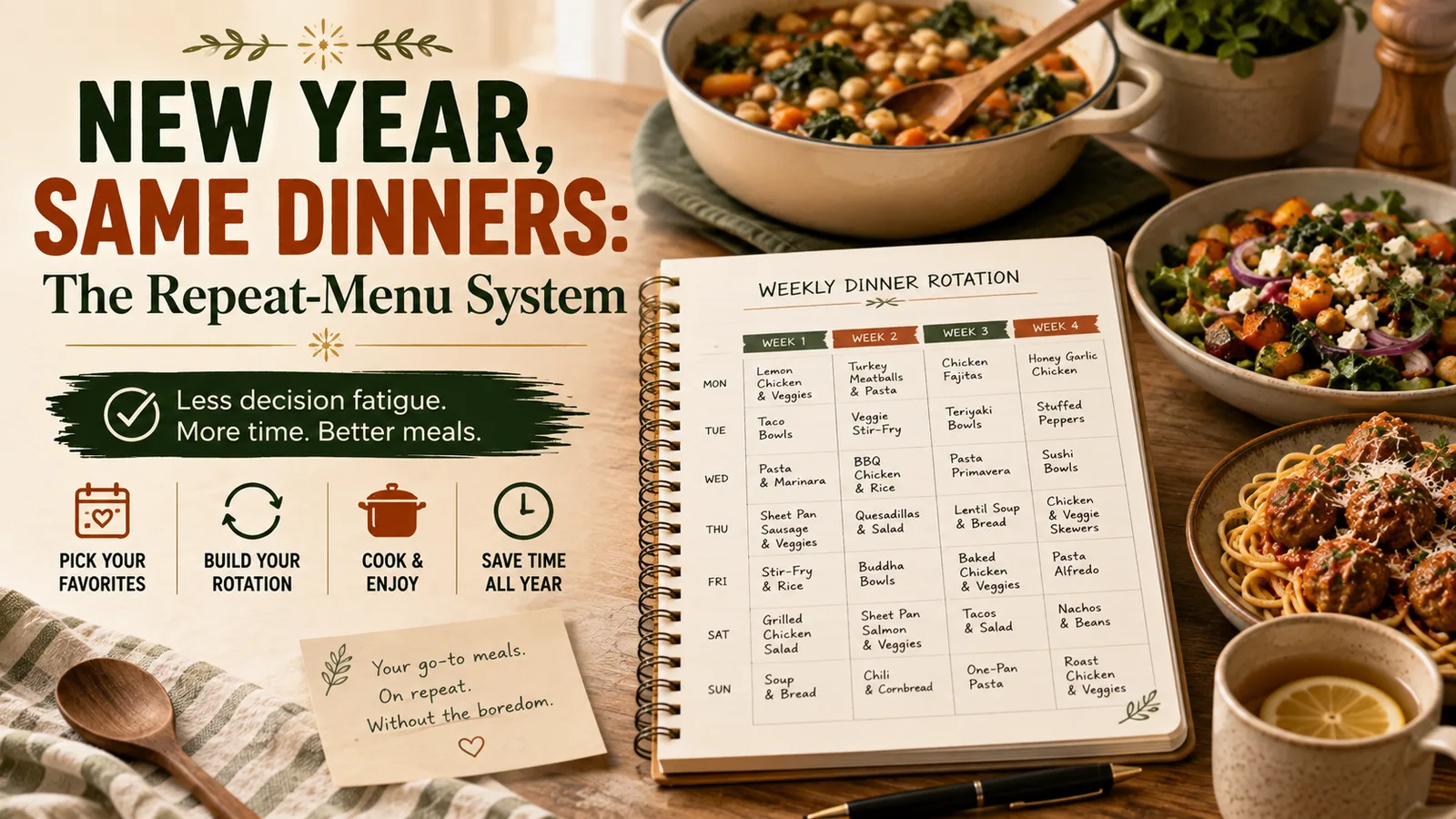
The repeat-menu system takes the opposite approach: keep the dinners that already work and organize them into a rotation.
You are not eating the same seven meals every week. You are building a reliable menu of 8-12 dinners that can be repeated, swapped, and varied without starting from zero.
Why repeating meals is a system, not a failure of creativity
Most households already repeat meals. The repetition just happens accidentally.
You make tacos because everyone eats them. Pasta appears again because the ingredients are easy. A sheet-pan dinner returns because Tuesday is busy.
The repeat-menu system simply makes those patterns visible.
Once you know your dependable meals, you can plan around them instead of pretending every week needs seven new ideas.
Step 1: find your 8-12 proven dinners
Do not brainstorm ideal meals. Look backward.
Think about the last two or three months and write down dinners that meet most of these criteria:
- the household usually eats them;
- ingredients are easy to find;
- you know roughly how to make them;
- cleanup is manageable;
- the cost fits your normal grocery week;
- they work on a real weeknight.
Your list might look like this:
- chicken tacos;
- spaghetti with meat sauce;
- sheet-pan chicken and vegetables;
- chili;
- burgers and oven fries;
- chicken rice bowls;
- quesadillas and beans;
- baked pasta;
- soup and grilled cheese;
- breakfast for dinner;
- slow-cooker pulled chicken;
- homemade pizza.
That is already enough to build several weeks without repeating the exact same calendar.
Step 2: sort the meals by job
A useful rotation needs different types of meals, not just different recipes.
Sort your list into four jobs:
| Job | What it solves | Examples |
|---|---|---|
| Fast | Very little time | quesadillas, eggs, pasta |
| Hands-off | Low active effort | sheet pan, slow cooker |
| Budget | Keeps weekly cost down | lentil soup, bean tacos |
| Comfort/family favorite | High acceptance | pizza, chili, burgers |
A meal can belong to more than one category.
The important thing is to notice whether your list is balanced. Twelve dinners that all take 45 minutes are not a useful weeknight system.
Step 3: build two weekly rotations
Start with two weeks instead of four.
Week A
- Monday: chili
- Tuesday: chicken tacos
- Wednesday: sheet-pan chicken
- Thursday: pasta with meat sauce
- Friday: pizza
- Saturday: chicken rice bowls
- Sunday: leftovers/flex
Week B
- Monday: slow-cooker pulled chicken
- Tuesday: quesadillas and beans
- Wednesday: baked pasta
- Thursday: soup and grilled cheese
- Friday: burgers and fries
- Saturday: breakfast for dinner
- Sunday: leftovers/flex
Now you have a 14-day rhythm with only 12 core meals.
You could repeat Week A and Week B throughout January and still have flexibility because ingredients, sides, sauces, and formats can change.
Step 4: vary the meal, not the decision
Repetition becomes boring when the exact plate never changes.
Instead of replacing the meal category, change one layer.
Taco night
Week 1: chicken tacos
Week 3: ground beef tacos
Next month: taco bowls
Pasta night
Week 1: spaghetti with meat sauce
Week 3: sausage and spinach pasta
Next month: baked ziti
Sheet-pan night
Week 1: chicken + potatoes + broccoli
Week 3: sausage + peppers + potatoes
The decision remains easy — “Tuesday is taco-style” — while the food still changes.
The One-Layer Variation Rule
Keep two parts of the meal familiar and change one:
same format + same side + different protein
or
same protein + same format + different sauce
That creates variety without rebuilding the grocery list.
Step 5: create ingredient overlap on purpose
A repeat menu becomes especially efficient when several meals share ingredients.
Suppose your Week A uses:
- chicken thighs;
- tortillas;
- shredded cheese;
- onions;
- peppers;
- rice;
- broccoli;
- tomato sauce.
Those ingredients can appear across tacos, bowls, sheet-pan dinners, pasta, and leftover lunches.
That means fewer specialty purchases and fewer half-used ingredients in the fridge.
When choosing your 8-12 meals, look for foods that share:
- proteins;
- vegetables;
- sauces;
- grains;
- toppings.
The best repeat menu does not just save planning time. It simplifies shopping too.
Step 6: keep one novelty slot
A system should not eliminate curiosity.
Give yourself one optional new-recipe slot per week.
If you want to try something new, use it there.
If you are tired, replace it with one of your repeat meals.
This prevents the common January pattern of planning five unfamiliar recipes and discovering on Wednesday that you do not want to cook any of them.
Simple rotation target5 repeat meals + 1 novelty + 1 flex
The repeat-menu grocery shortcut
Once you have a stable rotation, create a reusable base grocery list.
For example:
Always check
- tortillas;
- pasta;
- rice;
- canned tomatoes;
- beans;
- shredded cheese;
- eggs;
- frozen vegetables;
- onions;
- one or two proteins;
- bread;
- fruit.
Then add only the ingredients unique to that week’s meals.
This is faster than rebuilding a list from scratch every Sunday.
You can also mark pantry staples as check first rather than automatically buying them.
When a repeat meal should leave the rotation
A repeat menu is not permanent.
Remove a dinner when:
- people regularly avoid it;
- the ingredients have become too expensive;
- it creates too much cleanup;
- it no longer fits the schedule;
- you keep postponing it;
- another meal does the same job better.
Replace one meal at a time.
Do not redesign all 12 because one stopped working.
Build seasonal rotations instead of one forever menu
Your January rotation does not have to be your July rotation.
Winter might include:
- soups;
- casseroles;
- slow-cooker meals;
- baked pasta.
Summer might shift toward:
- wraps;
- salads;
- grilled food;
- no-cook dinners.
That gives you natural variety over the year while keeping planning simple within each season.
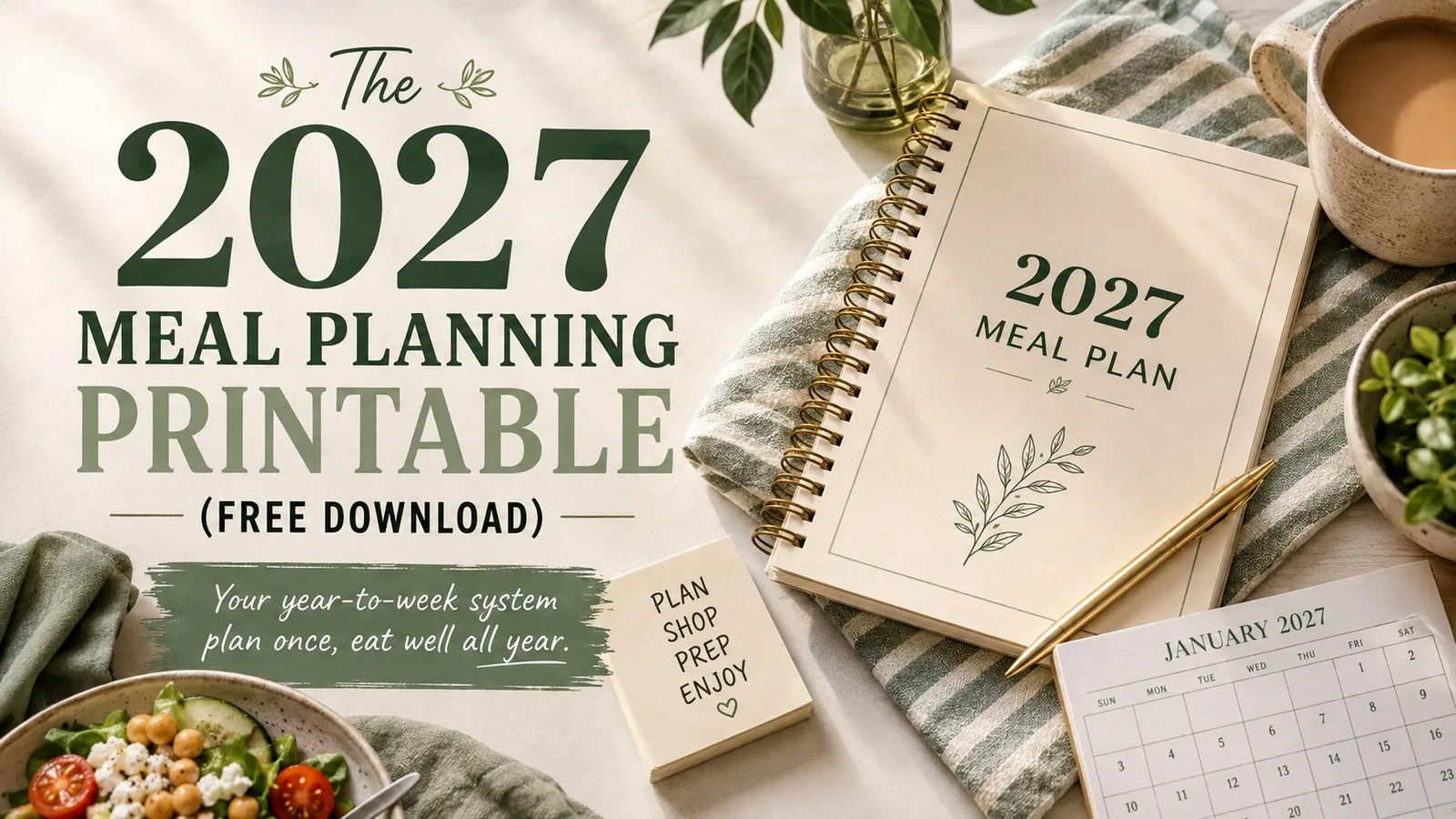
For the bigger structure, the 2027 Meal Planning Printable is designed around this same principle: plan patterns far ahead and exact meals close to the week when you will eat them.
The 10-minute repeat-menu setup
- Write down 8-12 dinners that already work
- Label each as fast, hands-off, budget, or favorite
- Build Week A and Week B
- Leave one flex night in each week
- Allow one optional new-recipe slot
- Identify shared ingredients
- Create a reusable base grocery list
- Replace only the meals that stop earning their place
Same dinners, much less thinking
The point of a January reset is not to prove that you can cook differently every night.
It is to make daily life easier.
A repeat-menu system gives you a short list of dinners that have already passed the hardest test: they work in your real household.
Use them. Repeat them. Change a sauce, protein, or side when you want variety. Add a new meal when you genuinely feel like it.
You do not need a new dinner identity for the new year. You need a menu that requires fewer decisions and still gets food on the table.
Turn the idea into a system.
Keep Reading