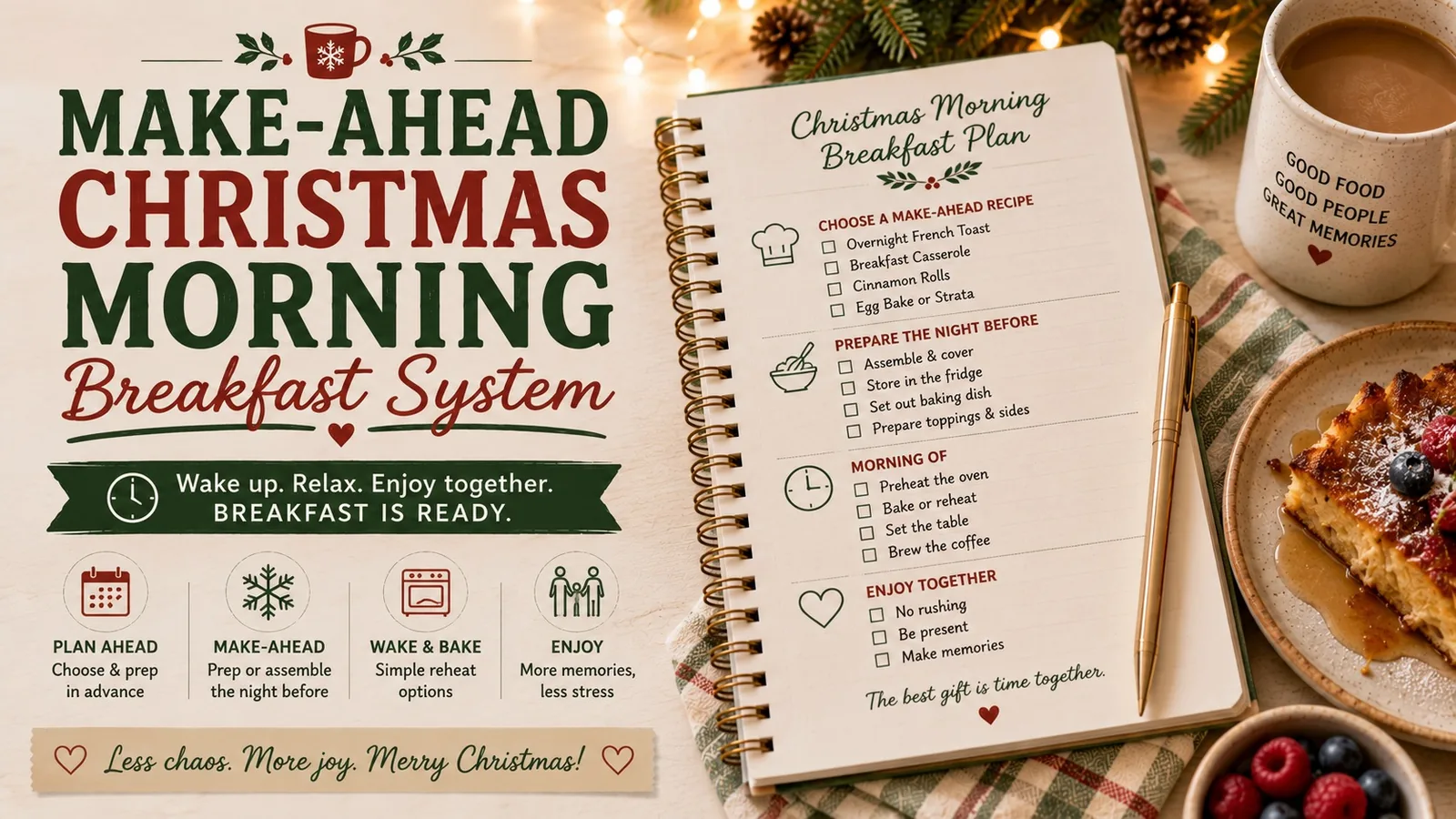
Christmas morning breakfast has a strange job. It should feel special, but it also has to survive late wake-ups, excited children, guests arriving at different times, gifts being opened, and a kitchen that may already be preparing for a bigger meal later.
The easiest solution is not a more impressive breakfast. It is a breakfast designed around holding, reheating, and almost zero morning decisions.
The 1–1–1 Christmas Breakfast System
Choose:
- 1 make-ahead main
- 1 cold/fresh side
- 1 self-serve extra
Add coffee, tea, or juice and stop.
That gives the table variety without creating three separate cooking jobs.
Choose a main that tolerates waiting
The best Christmas breakfast mains do not need to be eaten within 90 seconds of leaving the pan.
Good candidates include:
- baked French toast;
- breakfast casserole;
- baked oatmeal;
- strata;
- cinnamon-roll casserole;
- savory bread pudding;
- preassembled breakfast sandwiches that reheat well.
Less useful for a relaxed morning are foods that require batches and immediate serving, such as pancakes for ten people, individual omelets, fried eggs, or anything that leaves one person standing at the stove while everyone else is together.
Add one fresh thing that needs no cooking
The main is usually warm, rich, and filling. The easiest balance is something cold and simple:
- fruit platter;
- berries and oranges;
- yogurt;
- sliced melon;
- citrus salad.
Prepare it the night before if possible. Even washing fruit at 8:00 am is unnecessary work if it can happen at 8:00 pm instead.
Make the third component self-serve
The extra exists for flexibility, especially if people eat at different times.
Useful options:
- muffins;
- toast + butter/jam;
- pastries;
- yogurt cups;
- granola;
- bagels + cream cheese.
This means the first hungry person does not force the entire household to sit down at once.
The night-before setup
Christmas Eve is where the system succeeds.
- Assemble the breakfast main completely.
- Put it in the refrigerator in the dish it will bake in.
- Prepare fruit and refrigerate it covered.
- Set out plates, napkins and serving utensils.
- Put coffee supplies together.
- Place mugs where guests can find them.
- Set out shelf-stable extras.
- Write the oven temperature and bake time on a sticky note.
That sticky note is small but surprisingly useful. Christmas morning is not the moment to reopen a recipe and search for the baking instructions.
Work backward from when people are likely to eat
Do not schedule breakfast around an imaginary formal start time if your household does not behave that way.
Instead, choose a serving window.
For example: 8:30–10:00 am.
Then use a main that can finish near the beginning of that window and stay warm without damage.
Example:
| Time | Task |
|---|---|
| 7:45 | Take casserole from refrigerator |
| 8:00 | Preheat oven |
| 8:10 | Put casserole in |
| 8:45 | Set out fruit + extras |
| 9:00 | Breakfast ready |
| 9:00–10:00 | People serve themselves |
The point is not the exact clock. It is that breakfast does not require everyone to synchronize perfectly.
Protect your oven if Christmas dinner also needs it
If you will cook a large lunch or dinner later, breakfast should leave the oven available early.
Use one of these strategies:
- Bake breakfast early and finish by 10:00.
- Use a slow cooker overnight.
- Choose a main that reheats in the microwave.
- Use a no-bake breakfast if oven timing is already tight.
Holiday menus often fail because breakfast, appetizers and dinner are planned as separate events even though they share one kitchen.
Scale by pan, not by recipe math
For a crowd, think in serving containers rather than multiplying every ingredient mentally.
A practical rule:
- small household: one 8×8-ish dish;
- medium group: one 9×13-ish dish;
- larger group: two pans, preferably identical.
Two identical pans are often easier than one giant custom quantity because bake time and leftovers are more predictable.
The two-wave strategy for overnight guests
If your household wakes at different times, do not keep reheating the entire breakfast.
Serve in two waves:
Wave 1: main dish + fruit + coffee when the first group is ready.
Wave 2: reserve a portion of the main covered, then reheat that portion once for late risers.
This keeps the whole dish from drying out through repeated warming.
A complete menu that works
Christmas Morning for 8
Make-ahead main: overnight French toast casserole
Fresh side: orange, berry and grape platter
Self-serve extra: muffins + butter
Drinks: coffee, tea, orange juice
Backup: yogurt cups in the refrigerator
Everything except baking the casserole can be finished the night before.
If Christmas Eve is already overloaded
Use the 10-minute version instead:
- bakery pastries;
- yogurt;
- fruit;
- coffee;
- one store-bought savory item if you want it.
A make-ahead system should reduce holiday work, not become another tradition you feel obligated to perform perfectly.
The morning-after bonus
Choose a main that gives useful leftovers.
Breakfast casserole can become lunch with salad. Baked oatmeal reheats well. Muffins freeze. Extra fruit becomes snacks.
If the breakfast produces food you can use on December 26, it is doing two jobs.
The final rule
Christmas breakfast should be ready before the day becomes complicated.
That means choosing dishes for their behavior, not just their appearance: food that can wait, reheat, hold, and feed people on slightly different schedules.
When almost every decision is made the night before, Christmas morning gets to feel like Christmas morning instead of the first catering shift of the day.
Turn the idea into a system.
Keep Reading