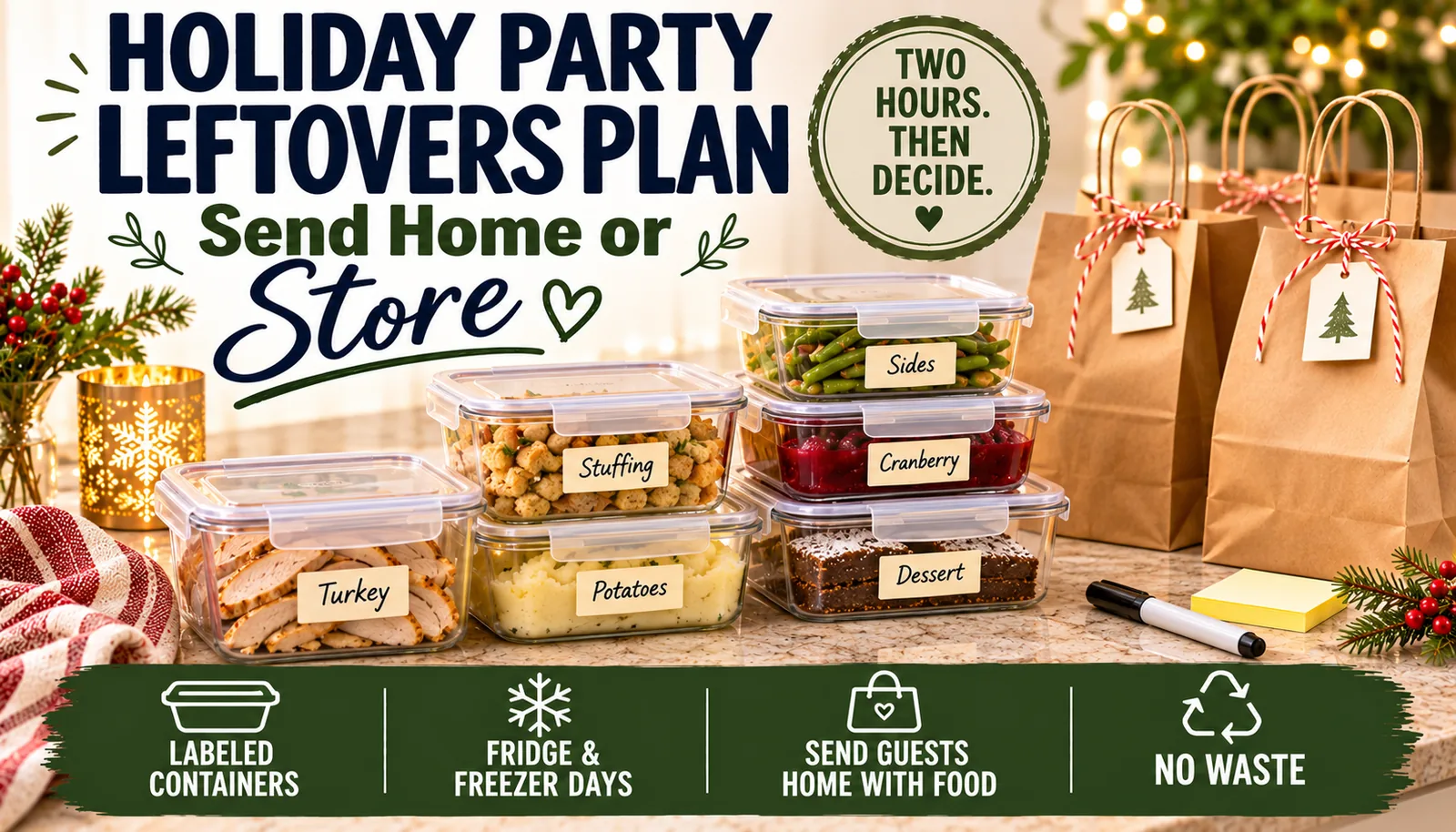
The party is over, you are tired, and the kitchen is full of half-empty trays with no label and no plan. Most of what happens to holiday party leftovers in the next two hours decides whether they become next week’s dinners or next month’s freezer mystery. One rule fixes both the waste and the guesswork.
The Send-Home-or-Store Rule
The Send-Home-or-Store Rule
Every leftover gets one of two jobs within two hours of the party ending: it goes home with a guest, or it goes into a labeled container in the fridge or freezer. Nothing sits on the counter “to deal with tomorrow.”
Step 1: Send guests home with containers
Have disposable containers or bags ready before the party ends, not scrambled together afterward. Offering guests leftovers to take home solves two problems at once: less food for you to store, and less food wasted.
- Keep a stack of containers or zip bags near the door or kitchen exit
- Offer dessert and side-dish leftovers first — they travel and reheat the easiest
- Skip sending home anything that has been sitting out close to the two-hour mark
Step 2: Sort what stays by how long it keeps
Once guests have left, sort everything that is staying into fridge-now or freezer-now, labeled with the date. For the full fridge-and-freezer timeline by food type, see How Long Do Batch-Cooked Meals Last? Fridge & Freezer Chart.
| Food | Fridge | Freezer |
|---|---|---|
| Cheese and charcuterie | 3 to 5 days | Not recommended (texture suffers) |
| Dips (cold) | 3 to 4 days | 1 to 2 months |
| Dips (baked, hot) | 3 to 4 days | 2 to 3 months |
| Cooked meatballs or sliders | 3 to 4 days | 2 to 3 months |
| Vegetable trays | 2 to 3 days | Not recommended |
| Cookies and baked sweets | 1 week | 2 to 3 months |
| Eggnog or dairy-based drinks | 3 to 5 days | Not recommended |
Step 3: Plan where the leftovers actually go
A fridge full of unlabeled odds and ends gets forgotten. Give each category a destination within the next few days:
- Cheese and crackers: a weeknight snack plate or lunch, as-is
- Dips: stir into pasta, use as a baked potato topping, or spread on a sandwich
- Meatballs: sliders, a quick pasta, or a sub sandwich
- Vegetable trays: a stir-fry, a soup, or an omelet filling
- Sweets: freeze what you will not eat within the week, rather than letting them go stale on the counter
If the party was specifically New Year’s Eve, see New Year’s Day Brunch for a Crowd for a full next-morning plan built entirely around leftovers.
Step 4: Deal with the drinks
Unopened wine and beer keep indefinitely and do not need a plan beyond storage. Opened wine is best used within 3 to 5 days (refrigerated, recorked); flat sparkling wine or cider is still fine for cooking even after it has lost its fizz. Pour out anything mixed with ice that has been sitting out, since diluted drinks do not keep.
If you hosted multiple parties close together
December often means more than one gathering in a short window. Rather than letting each party’s leftovers stack up separately, combine similar categories (all the cheese together, all the desserts together) so you are not managing five small half-used containers of the same thing.
More holiday hosting reading
For the party itself, see the Christmas Open House Menu System or the Cocktail Party Menu for 20. If leftovers are a recurring problem beyond just holiday parties, The Too-Many-Leftovers Problem: A Plan-Ahead Fix covers the everyday version.
Make this easier
Use the free Grocery List Generator to plan next week’s meals around what is already in your fridge and freezer, so leftovers get used instead of forgotten.
Turn the idea into a system.
Keep Reading