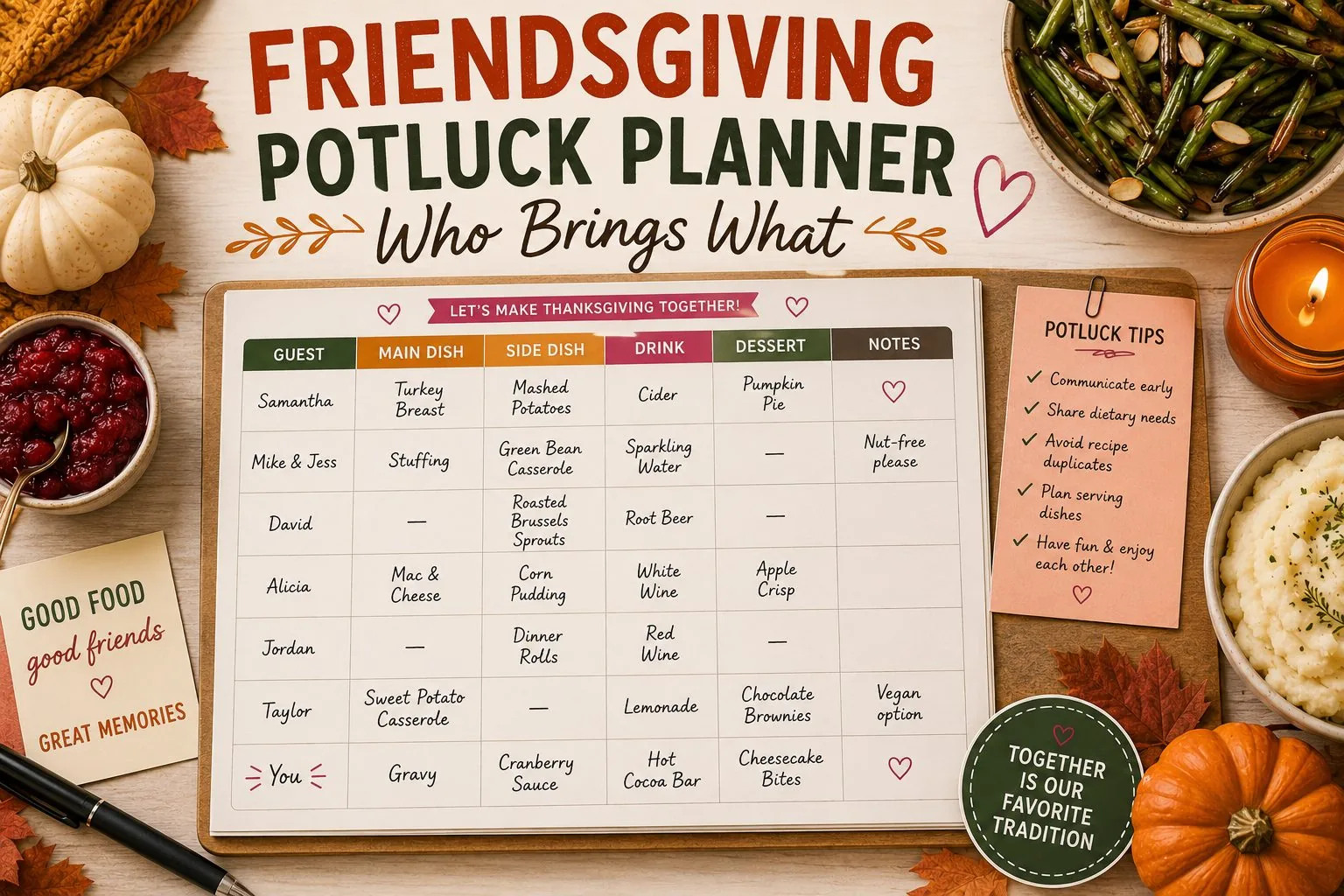
“Just bring whatever you want” is how a Friendsgiving potluck ends up with four desserts, one side dish, and nothing to drink. A potluck without categories isn’t actually planned — it’s a coin flip that happens to work out some years and leaves gaps in others.
The problem with an open-ended potluck ask
When guests are only asked to “bring something,” they default to whatever’s easiest for them — usually dessert, since it travels well and doesn’t need reheating. That’s how a 10-person Friendsgiving ends up with three pies and zero vegetables: not because anyone did anything wrong, just because nobody was assigned a category.
What this looks like for 12 people
Before the math, here’s what it actually looks like in practice:
- 1 main
- 2 sides
- 1 bread
- 1 dessert
- 1 drinks
That distribution isn’t a guess — it comes straight out of the Category Assignment System below, a fixed split scaled to your own guest count.
The Category Assignment System
Instead of an open invitation, every guest gets assigned a category — not a specific dish, just a lane — based on how many people are actually coming:
The Category Split
- Mains — 20% of dishes (turkey, ham, or a vegetarian main)
- Sides — 40% of dishes (the largest share — this is where most potluck dishes belong)
- Bread — 10% of dishes (rolls, cornbread, biscuits)
- Dessert — 20% of dishes (capped on purpose — this is where potlucks over-stack)
- Drinks — 10% of dishes (sparkling cider, wine, a punch)
One Guest = One Responsibility
Categories aren’t only about food. Every guest gets exactly one clear responsibility — sometimes that’s a dish, sometimes it’s something the table needs just as much:
- A main, side, bread, dessert, or drink
- Ice
- Serving utensils
- Leftover containers
One responsibility each, clearly assigned, is what actually prevents things from getting forgotten — not a longer group text the week of.
Two optional categories worth adding
Appetizers (Optional)
If guests tend to arrive an hour or two early, an appetizer keeps them fed while the main meal finishes. It doesn’t have to come out of the core 5-category split above — treat it as a bonus assignment for an early-arriving guest.
Host Supplies (Optional)
Ice, cups, napkins, plates, utensils, leftover containers — someone always ends up buying these. Naming it as its own assignable category means it’s not automatically the host’s job by default.
How many of each should you ask for?
Friendsgiving Category Calculator
Sides needed, for a 12-guest Friendsgiving2
The rule behind the numbers: roughly 1 dish for every 3 guests, split across categories by the percentages above — enough variety without ending up with more food than the table can hold.
Print your Friendsgiving Command Center
Friendsgiving Command Center
1. Hosting
- Guests: _______
- Date: _______
- Host: _______
2. Category Assignments
| Category | Dish | Who |
|---|---|---|
| Main | ||
| Side | ||
| Side | ||
| Bread | ||
| Dessert | ||
| Drinks |
3. Still Needed
- Main
- Side
- Dessert
- Drinks
4. Host Shopping
- _________________________
- _________________________
- _________________________
5. Day Before
- Who arrives first: _______________
- Who reheats: _______________
- Who brings ice: _______________
- Who brings coolers: _______________
Assigning responsibilities without micromanaging
- Text or message each guest their category or responsibility, not a specific dish — "can you bring a side?" leaves room for what they actually enjoy cooking
- Ask early — 2-3 weeks out — so nobody's scrambling the night before
- Keep a running list so you can see gaps forming before the day of, not after
- If two guests pick the same category, that's fine — it's covered by the count, not by a single named dish
Why categories beat an open invitation
An open “bring whatever” ask feels easier to send, but it pushes all the planning work onto the day of the party, when it’s too late to fix a table with three desserts and no vegetables. The Category Assignment System moves that decision to 2-3 weeks out, when a quick message can still balance the table.
Once categories are assigned, the Thanksgiving Command Center covers what you as host still need to shop for yourself, and the Thanksgiving budget split shows how much a potluck format actually saves off a fully host-cooked spread.
Turn the idea into a system.
Keep Reading