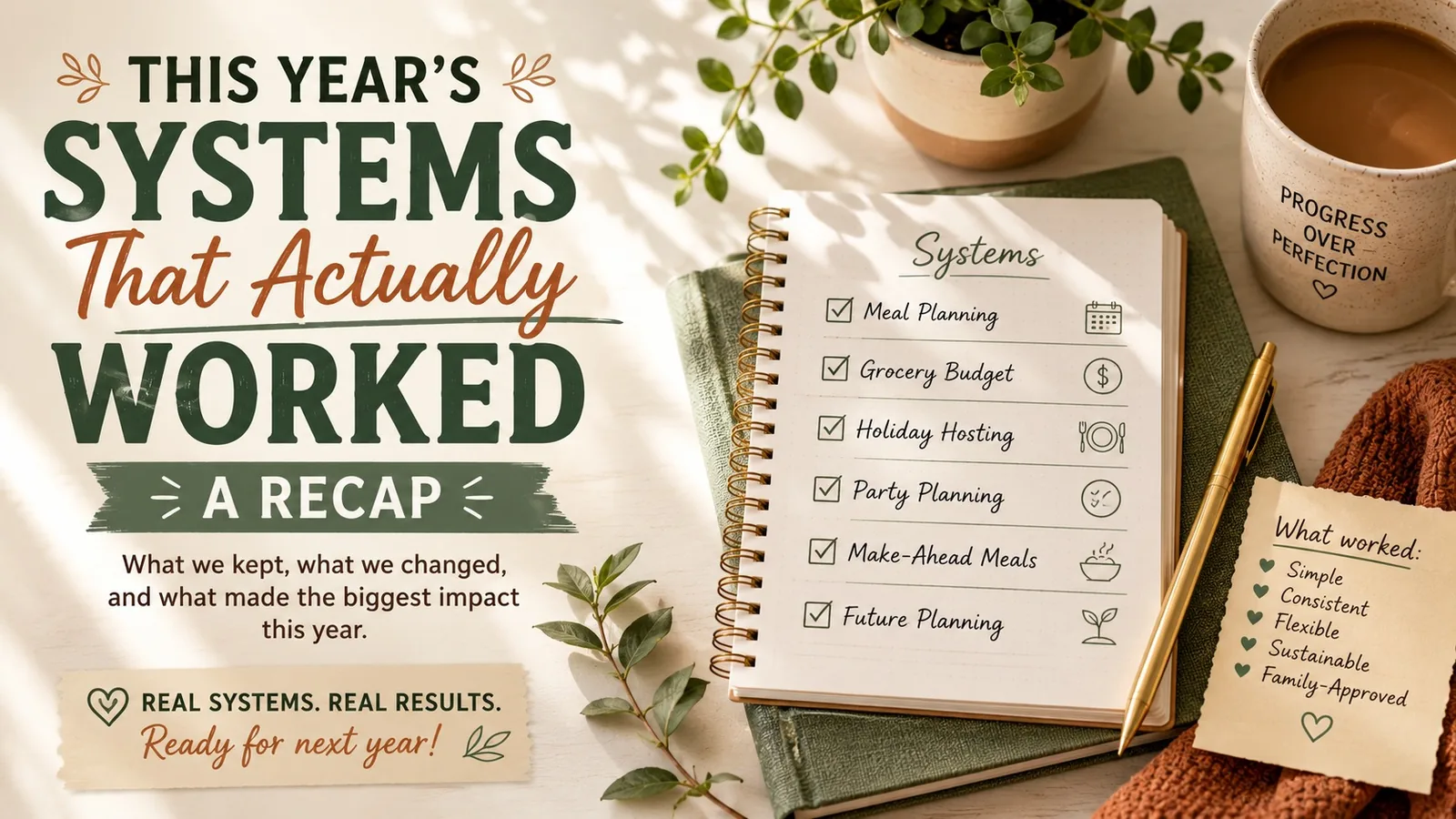
A year-end review is only useful if it changes what you do next year.
You do not need a beautiful journal spread or a list of resolutions. You need to identify which systems reduced friction in real life — and which ones quietly created more work than they saved.
This review takes about 20 minutes and gives you a short list of things worth repeating.
Start with evidence, not memory
Memory is biased toward unusually good and unusually bad weeks. Instead, look at whatever traces your household already created:
- your calendar;
- grocery receipts or banking history;
- meal-planning sheets;
- freezer labels;
- takeout orders;
- recurring recipes in your browser or notes app;
- weeks you remember feeling surprisingly easy.
You are not auditing yourself. You are looking for patterns.
Score each system on three things
For every routine you tried, give it a score from 0 to 2 in three categories.
| Question | 0 | 1 | 2 |
|---|---|---|---|
| Did it save time? | No | Sometimes | Clearly |
| Did it reduce decisions? | No | A little | A lot |
| Did we actually keep using it? | No | Off and on | Yes |
Anything scoring 5 or 6 is a keeper.
Anything scoring 3 or 4 may need simplifying.
Anything scoring 0–2 does not deserve automatic renewal just because it sounded like a good idea.
Review five areas, not your entire kitchen life
1. Weekly planning
Ask what actually helped you decide dinners.
Did a fixed planning day help? Did theme nights reduce decisions? Did planning five dinners instead of seven reduce waste? Did looking at the family calendar first prevent bad plans?
Keep the specific behavior that worked, not the whole ritual around it.
2. Grocery shopping
Look for the moment shopping became easier.
Maybe it was keeping one running list. Maybe shopping from five planned dinners instead of a giant recipe wish list. Maybe checking the freezer first saved duplicate purchases.
3. Batch cooking
Do not ask whether you batch-cooked “enough.” Ask which prep gave you the best return.
Perhaps cooking three pounds of ground meat was useful while preparing five full casseroles was exhausting. Perhaps chopping vegetables helped more than cooking complete meals.
Keep the bottleneck-solving prep.
4. Backup meals
Which meals rescued difficult nights?
Those are some of the most valuable meals in your system. Write them down intentionally.
A backup list of five proven options is more useful than 100 aspirational recipes.
5. Leftovers and food waste
What made leftovers actually get eaten?
Maybe designating Wednesday as leftovers night worked. Maybe freezing single portions worked better. Maybe putting a “use first” bin at eye level in the refrigerator made the difference.
Build your Keep / Change / Stop list
Do not finish the review with vague conclusions. Sort what you learned into three columns.
| KEEP | CHANGE | STOP |
|---|---|---|
| Five-dinner weekly plan | Sunday prep → 30-minute prep only | Planning seven unique dinners |
| Freezer chili | Make double, not triple | Complicated freezer sessions |
| Running grocery list | Check freezer before finalizing | Buying “just in case” produce |
This becomes next year’s operating manual.
The most useful question: what happened on bad weeks?
Any system works when life is calm. The strongest systems reveal themselves during busy weeks.
Think about the weeks with illness, deadlines, travel, school events, or general exhaustion.
What still worked?
If your default-dinner list survived, keep it. If elaborate meal prep disappeared immediately, redesign it. If frozen meals repeatedly prevented takeout, make freezer backups part of the normal plan instead of an emergency project.
The Bad-Week Test
A household system is durable when it can still function at roughly 60% effort.
If it requires perfect energy, perfect timing, and a full Sunday afternoon, it is fragile.
Choose only three upgrades for next year
The temptation after a review is to fix everything. Don’t.
Choose three upgrades with the biggest likely payoff.
For example:
- Create 12 default dinners.
- Plan only five dinners per week.
- Keep two emergency meals in the freezer at all times.
Those three changes can alter hundreds of dinner decisions across a year.
Keep a “proof list”
Write down five concrete examples of systems that made life easier.
Not “meal planning worked.” Something specific:
- The taco/bowl night used leftovers three times.
- The freezer soup saved us on two late Tuesdays.
- The five-dinner plan stopped us throwing away unused vegetables.
- Keeping breakfast simple made school mornings calmer.
- The holiday oven map prevented two dishes from needing the same space.
Why keep this list? Because six months from now, when a system feels boring, you can remember why you built it.
Your year-end reset
Finish with one page containing only:
- 5 systems to keep
- 3 systems to simplify
- 3 things to stop doing
- 5 default dinners
- 3 upgrades for next year
That’s enough.
A better food system does not come from becoming more disciplined every January. It comes from noticing what already made life easier and making those useful behaviors easier to repeat.
Turn the idea into a system.
Keep Reading